HFIP in Additive Manufacturing & 3D Printing Research
Our consistent product ensures that reproducible results are guaranteed, with no artifacts in analysis or unwanted and unpredictable by-products in syntheses. Fluorochem is REACH registered, so capable of supplying the quantities you need, while still retaining the highest levels of quality and retaining excellent affordability.
HFIP in Research and Manufacturing
HFIP was initially discovered in the 60s, but remained restricted in use until recent years. Now, it is known as a highly versatile solvent, valued in a variety of specialist R&D fields. HFIP’s extreme polarity and large fluorine content means it benefits countless chemical reactions, and improves the solubility of all kinds of substances, even when used in small quantities.
Polymer Solubility for Advanced Materials Research
HFIP is capable of dissolving a wide range of polymers, including some that are typically difficult to dissolve using standard organic solvents
This solubility profile means HFIP is commonly used in studies involving:
Polymer morphology
Ink and solution preparation for research
Fibre formation investigations
Material compatibility analysis
Note: Use conditions and suitability depend on the specific research methods and laboratory protocols.
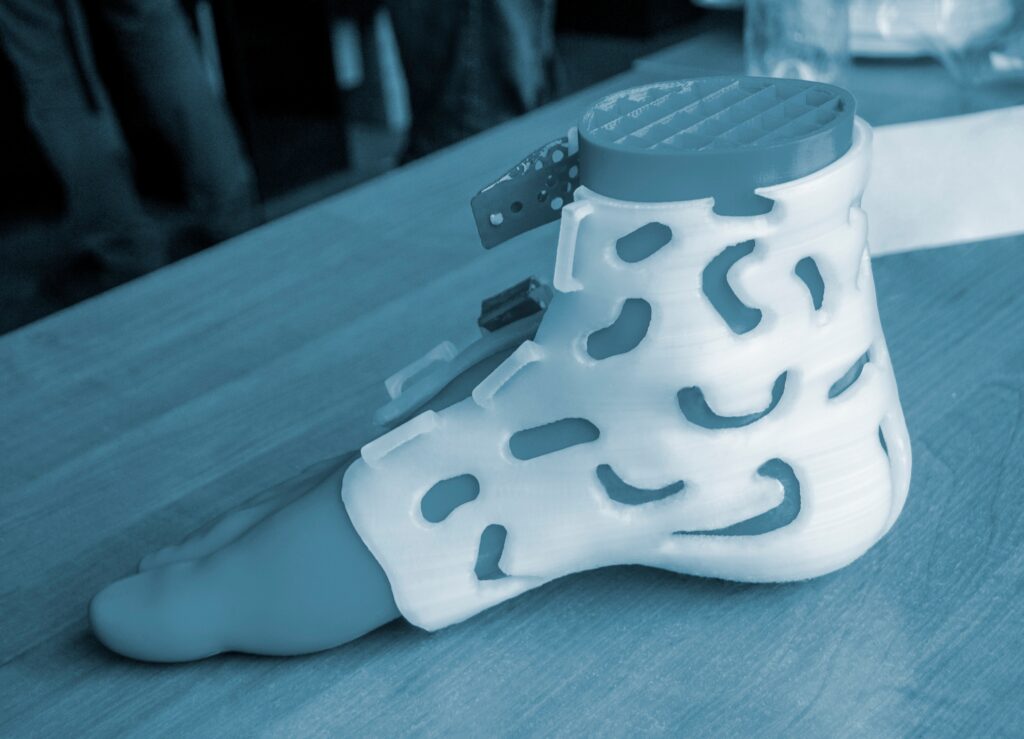
HFIP in Solution-Based AM & Polymer Processing Studies
Low solution viscosity, fast evaporation and the ability to support formation of fine structures and fibres mean HFIP has been adopted into experimental AM techniques, especially those focused on polymer dissolution and solution processing. HFIP is referenced in relation to:
Solution-based 3D printing
Direct ink writing (DIW) research
Micro-extrusion studies
Solvent-casting approaches
Fibre deposition and structural research
HFIP in Electrospinning and Nanofibre Research
HFIP is widely used in electrospinning research to help achieve fibre uniformity desirable surface morphology of:
PVDF nanofibres
PCL nanofibres
Nylon-based nanofibres
Electrospinning laboratories often choose HFIP when working on the following materials:
Filtration membranes
Textile research
Biomedical materials
Sensor technologies
Advanced fibre composites
Use depends on institutional protocols and safety standards.
HFIP in Biomaterials & Bioprinting Research
HFIP is known to support beta-sheet formation in silk fibroin under certain conditions, which is relevant for mechanical stability in research-stage scaffolds.
Silk fibroin solutions
PCL-based biomaterials
Prototype scaffolds for tissue engineering research
Experimental drug-delivery matrices
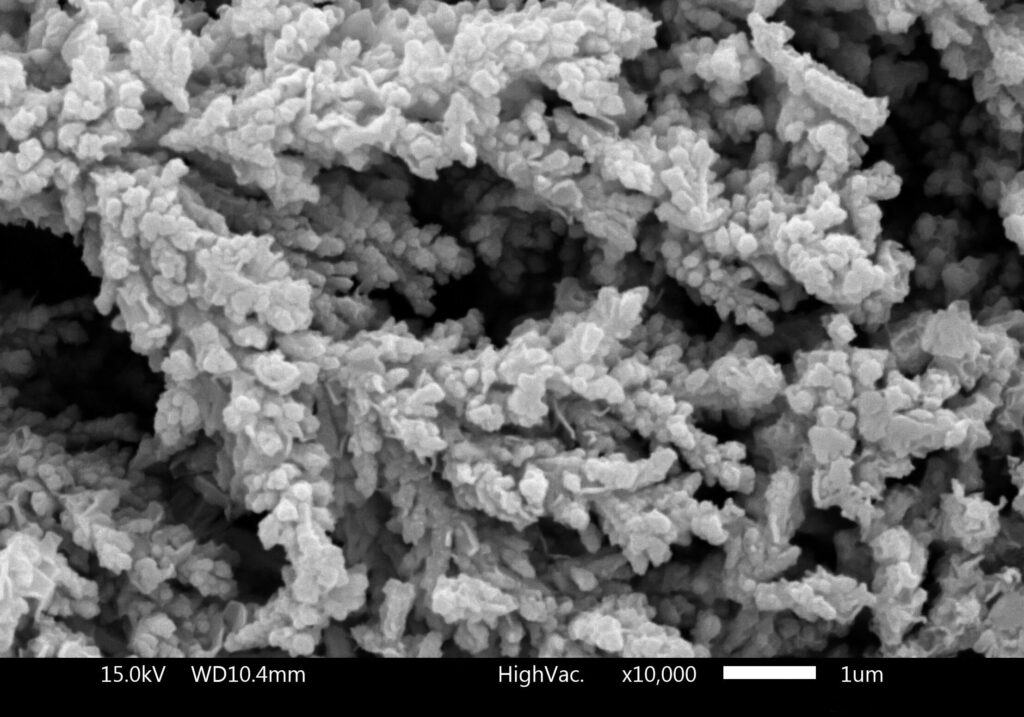
High-porosity materials for academic studies
Why Research Groups Choose Fluorochem for HFIP
Fluorochem supplies HFIP to academic institutions, industrial R&D laboratories, materials developers and medical research groups across the UK and EU.
Supplier Advantages
Large UK and EU inventory
Pack sizes from 1 L bottles to bulk quantities
Consistent quality with full COA
Reliable logistics for time-sensitive projects
Support from a longstanding specialty chemical supplier
Safety and Handling Information
Hexafluoro-2-propanol is a hazardous solvent that must only be handled by trained personnel in appropriately equipped laboratory or industrial environments.
Researchers should refer to:
Their internal safety protocols
Local regulations
Fluorochem’s SDS (available upon request)
Appropriate PPE, engineering controls, ventilation and storage procedures are essential.
Thermostable Peroxygenase from Thermophile’s Self-Sufficient CYP
Another look at the brilliant research that molecules from Fluorochem are applied to. This time advances in more stable, more practical, biocatalytic methods, using cytochrome P450 monooxygenases (CYPs), led by recently qualified PhD student Matthew Podgorski, from the laboratory of Stephen Bell at the University of Adelaide. This paper builds on a series of studies from Bell’s group, including recent ACS Catalysis and Chemistry Europepapers, where Fluorochem-supplied fatty acids and aromatic substrates were used to probe CYP enzyme activity.
Enzymatic biocatalysis continues to make great strides in chemical synthesis. Increasingly applied to difficult transformations, it is producing results in a more sustainable manner than many traditional chemical techniques. However, to practically use enzymes in larger scale or industrial applications requires these proteins to survive long stretches at ambient temperature, or even retain activity after heating cycles. Enzymes derived from thermophiles are an obvious source of biocatalysts that can operate at higher temperatures, don’t require cold storage and are generally more robust, often being more resistant to organic solvents or other extreme environments.
Palmitoleic acid bound adjacent to heme of P450BM3 (Li, H.Y., Poulos, T.L. (1997) https://doi.org/10.2210/pdb1FAG/pdb)
Cytochrome P450 monooxygenases (CYPs) are well established enzymes for performing challenging oxidations: notably including C-H activations, producing hydroxylated products regio- and enantioselectively. So far, the majority of characterised CYP enzymes originate from mesophiles, and display only moderate temperature stability. However, several have been discovered that do withstand higher temperatures; a handful have been reported that retain their function at temperatures greater than 75 °C. Ideally, a thermally stable CYP would be ‘self-sufficient’, meaning an electron transfer domain is joined to the heme active site; otherwise the identification of suitable transfer partners, also thermally stable, that function efficiently with thermophile CYPs is a significant challenge.
Thermostable P450BM3-like oxygenases are a promising target, as these have been investigated in detail. Engineering them to oxidise unnatural substrates (essential for chemical synthesis) is well understood and these methods could be adopted for related oxygenases. Currently, few thermostable enzymes from the CYP102, or similar self-sufficient families have been discovered. Interestingly,Thermosporothrix hazakensis contains a gene encoding an enzyme from this family. The recently discovered, mildly thermophilic bacterium, thrives in the elevated temperatures found in compost, ranging from 31-58 °C. Its P450BM3-resembling enzyme has been demonstrated to oxidise palmitic acid. It should also be self-sufficient, containing a reductase (CPR) domain adjacent to the heme domain.
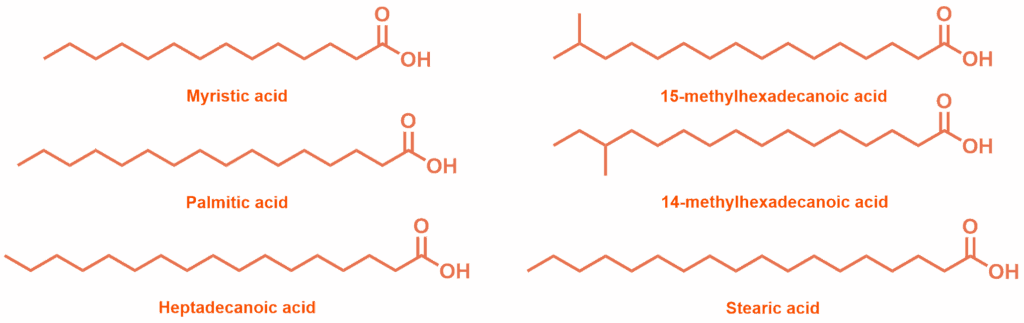
Initial fatty acid substrates screened for binding to WT CYP102 holoprotein
Possible substrates for the wild-type (WT) CYP102 holoprotein were identified through changes in the UV-Vis absorbance spectrum (Soret band): substrates binding close to the heme displace a water ligand, producing a shift in absorbance. The saturated palmitic acid (C16) and margaric acid (C17) induced the biggest shifts in absorbance, while acids with shorter chains, and those with more than 17 carbons showed a reduced effect. Adding methyl branching to palmitic acid, and increasing saturation, also appeared to reduce the binding effect. The accuracy of the UV-Vis proxy measurement was confirmed with binding assays of 15, 16 and 17-carbon chain acids: longer-chain fatty acids bound most strongly, with margaric acid showing particularly high affinity (KD = 0.30 μM). These trends align with P450BM3, suggesting the enzyme has similar physiological substrates.
However, in vitro activity was low compared to P450BM3, possibly due to the loss of FAD or FMN cofactors in purification and after incubating at 50 °C, all catalytic activity ceased. In whole-cell (E. Coli) reactions, yields of oxidised metabolites (predominantly hydroxylation near the chain terminus) increased, once again showing resemblance to P450BM3 with a similar ratio of products. With the WT holoprotein showing a lack of thermostability (despite its origin in bacteria that thrive at 50 °C) and low in vitro activity, but with a reductase adjacent to its heme domain, the heme domain was a good candidate for further investigation. It was converted into a peroxygenase: exchanging the catalytically critical glutamate-threonine (ET) pair adjacent to the heme iron with glutamine-glutamate (QE), as found in the peroxygenase CYP255 family, creating the QE heme domain mutant, dubbed ‘HazakQE’.
The resultant reduced form of the protein responded to carbon monoxide with a comprehensive shift in the Soret band, indicating a functional CYP enzyme. This response was maintained after heating at 50 °C for thirty minutes, with 94% similarity in the UV-Vis region; however, heating to 65 °C appeared to denature it. When treated with H2O2 (2-10mM) at 30 °C degradation of the enzyme was observed, with higher concentrations of bleach accelerating the process. In the presence of fatty acids, the effect is reduced, presumably due to shielding of the heme.
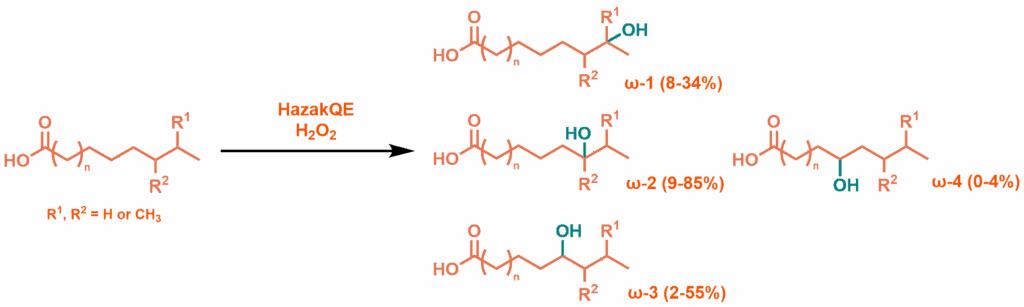
Distribution of hydroxylated products from reaction with HazakQE peroxygenase
Testing the palmitic, myristic, 14-methylhexadecanoic and 15-methylhexadecanoic acids with HazakQE (after a pre-incubation for 30 minutes at 50 °C) and H2O2 confirmed the mutant’s functionality. At low concentrations of enzyme and peroxide, over 30 minute reaction times, the same metabolites produced by the WT holoprotein were observed, in similar ratios. At higher concentrations and reaction lengths, complex mixtures of over-oxidation products were produced, showing that the initial metabolites are also potential substrates for the enzyme and that the turnover number was good: >250 for longer fatty acids, a significant improvement over previously reported P450BM3 mutants. WT P450BM3 denatures at 43 °C, but previously reported efforts to convert the more stable heme domain into a peroxygenase have produced a more stable T268E mutant. Comparison of this mutant, from a less thermophilic origin, with HazakQE reveals equivalent thermostability, with both beginning to show small reductions in activity when heated to 55 °C.
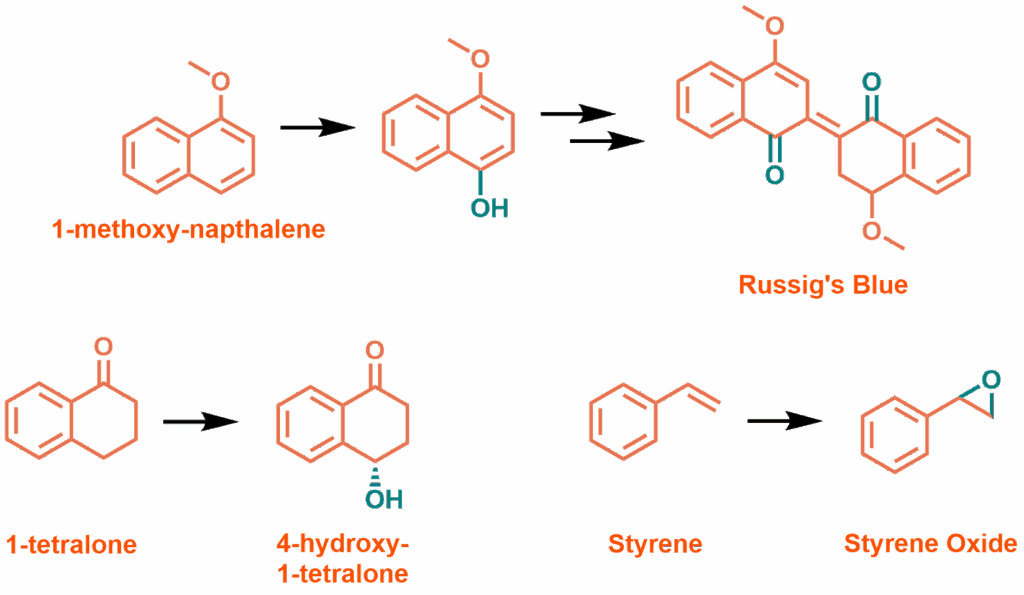
For use as a practical synthetic tool, biocatalytic enzymes need to work on non-physiological substrates: styrene, α-tetralone and 1-methoxynaphthalene are known to be metabolised by other CYP enzymes. 1-methoxynaphthalene is particularly useful for testing enzymatic activity, as the product of its oxidation is the strongly absorbing dye, and therefore easily quantified, Russig’s Blue. This oxidation was efficient at 30 °C and 40 °C (with and without a 50 °C pre-incubation), but at 50 °C was barely functional. While the enzyme should be able to withstand the greater temperatures, the effect of oxidative damage from the peroxide present is probably increased. Oxidation of α-tetralone is similar, with higher temperature reactions producing significantly less product. This reaction was also found to be slightly enantioselective, producing 60% ee of what is assumed to be the S-enantiomer. WT P450BM3 and the derived mutant T268E produce hydroxylated products with a 30% ee. HazakQE oxidation of styrene is essentially racemic, whereas T268E does produce a slight excess of the R-enantiomer. Despite this, yield and turnover are greater for HazakQE (480 μM, 160 TTN vs 360 μM, 120 TTN).
Non-physiological substrates oxidised by HazakQE and H2O2
By characterising a self-sufficient CYP102 from T. Hazakensis and subsequent modification of the heme domain, a thermally stable peroxygenase (HazakQE) was developed. While more resistant to heating than the holoprotein and other mesophilically derived CYP enzymes. While it was not more themostable than the heme domain of P450BM3, HazakQE maintained activity at 50 °C and outperformed existing mutants in efficiency. Furthermore it stands as proof of concept that the simple two amino acid mutation strategy, paired with the accessible screening assay utilising Russig’s Blue, opens the door to faster discovery of robust CYP biocatalysts. Together with earlier work on Fluorochem-sourced styrene derivatives, benzoic acids and their metabolites, HazakQE underscores how accessible molecules enable discovery of robust CYP biocatalysts.
Compliance Landscape and Practical Guidance for Chemical-Related Sectors
As regulatory oversight tightens globally, organizations across schools, research institutes, pharmaceutical and chemical manufacturers, food producers, agrochemical firms, e‑cigarette manufacturers, and chemical distributors must adopt robust compliance practices. Compliance is no longer a narrow legal checklist; it affects product safety, environmental performance, worker health, public trust, and market access. This article outlines the current compliance landscape and offers practical steps organizations can take to meet regulatory demands in a straightforward, actionable way.
Regulatory Trends Shaping Compliance
Fragmentation and detail. Regulations are expanding from high-level safety goals to highly detailed requirements covering raw materials sourcing, processing conditions, labeling, storage, transport, waste handling, and post-market surveillance. Authorities increasingly publish technical standards, permissible limits (e.g., residue thresholds), and specific documentation requirements.
Digitalization and traceability. Electronic records, batch traceability, and digital reporting are becoming standard. Regulators and customers expect verifiable digital audit trails for quality checks, chain-of-custody information, and incident reports.
Cross-sector integration. Food safety, environmental protection, workplace safety, and chemical management are being enforced in a coordinated fashion. For example, a chemical incident may trigger parallel investigations under environmental, occupational health, and product safety laws.
Increased scrutiny on novel products. Emerging categories such as e‑cigarettes, specialty chemicals, and novel formulations face more intensive review. Requirements commonly include detailed composition disclosure, toxicology data, labeling restrictions, and marketing controls.
Global harmonization and local divergence. International frameworks (e.g., GHS, ISO standards, GMP principles) provide common baselines, but local jurisdictions often add unique registration, reporting, or limit values that must be respected.
Sector-Specific Compliance Priorities
Academic and research institutions: Focus on chemical inventory control, safe storage, waste segregation and disposal, risk assessments for laboratory procedures, institutional biosafety where applicable, and training/permit systems for researchers. Documentation of hazardous chemicals and local approvals for certain reagents are essential.
Pharmaceutical and fine chemicals: Adhere to GMP, validated quality systems, strict change control, stability testing, impurity profiling, and full documentation for regulatory submissions. Pharmacovigilance and post-market monitoring are relevant for finished drug products.
Food and beverage: Comply with food safety management systems (e.g., HACCP, ISO 22000), ingredient and additive limits, labeling rules, allergen declarations, and supplier guarantees for residue and contamination levels.
Agrochemicals and agricultural products: Observe registration requirements, maximum residue limits (MRLs), label instructions, and safe handling/transport rules. Environmental risk assessments and worker protection measures are critical.
E‑cigarettes and novel nicotine products: Prepare for strict ingredient disclosure, emissions testing, youth protection policies, advertising constraints, and often pre-market notification or authorization processes.
Chemical distributors and logistics: Ensure accurate Safety Data Sheets (SDS/MSDS), appropriate classification and labeling (GHS), compliant packaging and transport (ADR/IATA/DOT as applicable), and controls on sourcing to prevent diversion or counterfeit materials.
Core Elements of an Effective Compliance Program
Governance and accountability. Appoint compliance leaders, define roles and decision authorities, and embed compliance into business objectives. Senior management commitment and regular board-level reporting help maintain momentum.
Risk-based policies and procedures. Map operations to regulatory obligations and prioritize controls where risk is highest (toxic intermediate handling, waste streams, product labeling errors). Document standard operating procedures (SOPs) for high-risk tasks.
Supply chain due diligence. Implement supplier qualification, contractual compliance clauses, periodic audits, and incoming material testing. Confirm suppliers’ licenses, SDS accuracy, and traceability for critical inputs.
Quality systems and documentation. Maintain controlled documents, change control processes, batch records, calibration logs, and electronic audit trails. Ensure retention periods meet legal requirements.
Training and competency. Deliver role-specific training on chemical hazards, emergency response, PPE, regulatory changes, and recordkeeping. Use competency assessments and refresher programs.
Monitoring, testing, and internal audit. Conduct routine sampling, in-process testing, and environmental monitoring. Use internal audits to verify conformance and drive corrective actions.
Incident management and corrective action. Establish clear incident reporting, root-cause analysis, recall procedures (if applicable), regulatory notification timelines, and CAPA (corrective and preventive action) follow-through.
Third-party assessment and certification. Use accredited third-party audits and certifications (e.g., ISO, GMP audits, HACCP) to validate systems and provide customers and regulators independent assurance.
Practical Steps for Immediate Improvement
Create a compliance gap assessment: inventory obligations (local law, international standards, customer requirements), then score gaps by risk and effort required to fix.
Prioritize “quick wins”: update SDS and labels, segregate hazardous waste, institute basic electronic recordkeeping for key quality metrics, and train frontline staff on immediate hazards.
Engage expertise where needed: regulatory consultants, legal counsel, or accredited labs can accelerate compliance for product registration, complex testing, or legal interpretations.
Invest in digital tools: adopt a chemical management system or quality management software that centralizes SDS, batch records, supplier info, and audit trails.
Run tabletop drills and emergency simulations: validate response plans for spills, exposures, or product issues and refine communication protocols.
Closing Note Compliance is an ongoing management discipline that combines people, processes, and technology. Organizations that treat compliance as a strategic asset rather than a cost center reduce legal and operational risk, strengthen brand trust, and improve access to markets. By implementing risk-based controls, maintaining accurate records, investing in staff competency, and staying abreast of regulatory changes, institutions across academia and industry can meet evolving demands while supporting safe, sustainable operations.
Request a Quote
Fill out the form and our team will contact you shortly