News & Insights
Stay informed with the latest breakthroughs, partnerships, and thought leadership from the chemists leading the future of sustainable materials, pharmaceuticals, and advanced manufacturing.
Fmoc-Nalpha-methyl-4-chloro-L-phenylalanine (CAS 1217716-50-1): High-Purity SPPS Building Block
Key Takeaways
- Product: Fmoc-Nalpha-methyl-4-chloro-L-phenylalanine
- CAS Number: 1217716-50-1
- Molecular Formula: C25H22ClNO4
- Molecular Weight: 435.90 g/mol
- Common Synonyms: Fmoc-N-Me-Phe(4-Cl)-OH, N-Fmoc-N-methyl-4-chloro-L-phenylalanine, Fmoc-L-MePhe(4-Cl)-OH
- Main Application: Specialized amino acid building block for Solid-Phase Peptide Synthesis (SPPS)
- Key Purchasing Factors: Purity, chiral purity, coupling performance, analytical documentation, batch consistency, packaging, and supply capacity
Introduction
When developing a new peptide, researchers often need more than the standard 20 natural amino acids. Modified amino acids allow chemists to change the shape, stability, activity, or other properties of a peptide and are therefore widely used in drug discovery and peptide research.
Fmoc-Nalpha-methyl-4-chloro-L-phenylalanine, also known as Fmoc-N-Me-Phe(4-Cl)-OH, is one such specialized building block. It combines an N-alpha methyl group with a 4-chloro-substituted phenylalanine structure and is designed for use in Fmoc-based peptide synthesis.
For buyers, however, choosing this material is not simply a matter of matching the product name and CAS number. Buyers should evaluate several factors before moving from laboratory testing to larger-scale procurement, including purity, stereochemical integrity, coupling performance, analytical documentation, and supply reliability.
This guide explains the product from both a technical and B2B sourcing perspective, so buyers can determine what specifications and supplier information they should request.
1. Product Identification & Technical Specifications
What Is Fmoc-Nalpha-methyl-4-chloro-L-phenylalanine?
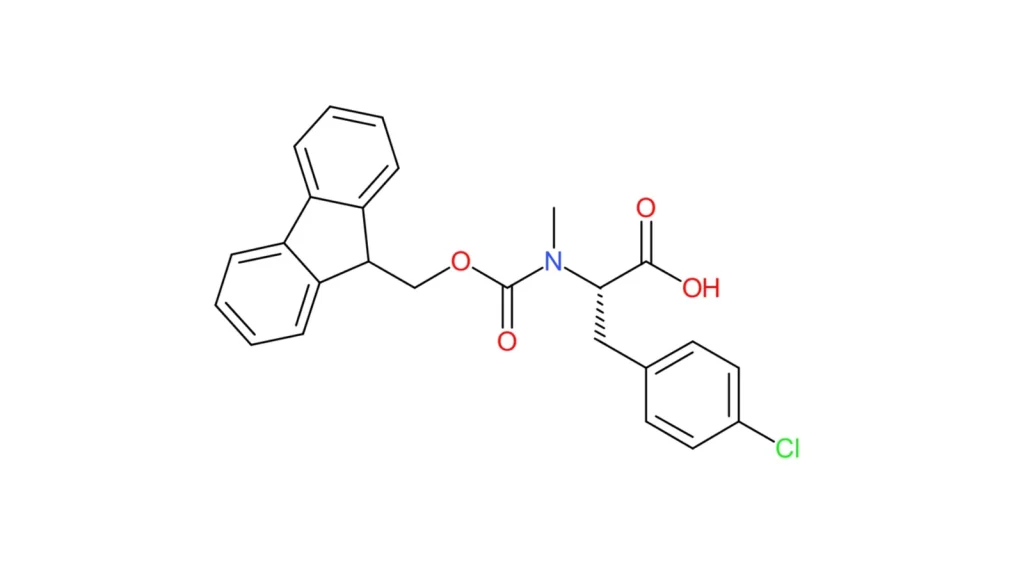
Fmoc-Nalpha-methyl-4-chloro-L-phenylalanine is a protected, N-methylated form of 4-chloro-L-phenylalanine.
The name looks intimidating, but its structure can be understood through three simple components:
- Fmoc: A protecting group used to temporarily block the amino group during peptide synthesis.
- N-alpha methyl: A methyl group attached to the backbone nitrogen, changing the behavior and conformation of the resulting peptide.
- 4-chloro: A chlorine atom attached to the phenyl ring of the phenylalanine side chain.
Together, these modifications give researchers a useful building block for exploring modified peptide structures and structure-activity relationships (SAR).
Technical Specifications
| Parameter | Information |
| Product Name | Fmoc-Nalpha-methyl-4-chloro-L-phenylalanine |
| CAS Number | 1217716-50-1 |
| Synonyms | Fmoc-N-Me-Phe(4-Cl)-OH; N-Fmoc-N-methyl-4-chloro-L-phenylalanine; Fmoc-L-MePhe(4-Cl)-OH |
| Molecular Formula | C25H22ClNO4 |
| Molecular Weight | 435.90 g/mol |
| Product Type | Protected N-methyl amino acid |
| Primary Application | Solid-Phase Peptide Synthesis (SPPS) |
| Typical Quality Focus | Chemical purity and chiral purity |
2. SPPS Application & Reaction Considerations
Why Use an N-Methyl Amino Acid in Peptide Design?
N-alpha methylation changes how an amino acid behaves after it becomes part of a peptide chain.
Replacing the normal N-H group with N-CH3 can influence the peptide backbone’s shape, flexibility, and hydrogen-bonding behavior. In medicinal chemistry, these changes may help researchers investigate properties such as proteolytic stability, conformational preference, membrane permeability, and biological activity. However, the effect depends strongly on where the N-methyl group is introduced and on the overall peptide sequence.
The 4-chloro substitution provides an additional structural change on the phenylalanine side chain, allowing researchers to explore how changes in the aromatic substituent may affect peptide properties and biological activity during structure-activity relationship (SAR) studies.
In other words, the value of this amino acid is not simply that it is a different version of phenylalanine. Its structural modifications give researchers another way to fine-tune peptide molecules during medicinal chemistry and peptide design.
Why Can N-Methylated Amino Acids Be More Difficult to Couple?
This is one of the most important practical considerations when using Fmoc-Nalpha-methyl-4-chloro-L-phenylalanine in SPPS.
N-alpha methylation creates additional steric hindrance around the peptide backbone nitrogen. After an N-methyl amino acid has been incorporated into a peptide chain, coupling the following amino acid can be more challenging because the secondary amine is less accessible than a conventional primary amine. The difficulty can become even greater when two N-methyl amino acids need to be coupled consecutively.
Researchers may therefore evaluate coupling reagents commonly used for sterically hindered N-methyl residues, including HATU or PyAOP, together with a suitable base such as DIPEA. Published peptide-synthesis examples have successfully used HATU/DIPEA systems for N-methyl phenylalanine derivatives, although the optimal conditions depend on the specific sequence and synthesis method.
Depending on the peptide sequence and synthesis platform, additional measures such as longer coupling times or double coupling may also be considered. The exact conditions should be optimized for the individual peptide sequence rather than treating one protocol as universally applicable.
How Can Coupling Problems Be Reduced?
If incomplete coupling is observed, several factors can be reviewed:
- Confirm that the building block meets the required chemical and chiral purity specifications.
- Check whether the building block dissolves adequately in the selected synthesis solvent.
- Review the coupling reagent, reagent equivalents, and reaction conditions.
- Consider extending the coupling time when appropriate.
- Use double coupling if a single coupling cycle does not provide sufficient conversion.
- Monitor the synthesis to identify incomplete reactions or other side reactions at an early stage.
These checks are particularly useful when working with N-methyl amino acids because coupling performance can vary with the peptide sequence, resin, neighboring residues, and reaction conditions. Consistent building-block quality also matters: significant batch-to-batch variation can make synthesis optimization and troubleshooting more difficult.
3. How to Choose High-quality Amino Acid Building Blocks
For a specialized amino acid, a high assay value alone does not tell the whole story.
A peptide synthesis supplier should be able to provide evidence of both chemical purity and stereochemical purity. In simple terms, chemical purity tells you how much of the desired compound is present, while chiral purity helps confirm that the material has the intended three-dimensional configuration.
For many research applications, buyers may specify HPLC purity ≥98% and chiral purity ≥99% ee, depending on their internal quality requirements.A lot-specific Certificate of Analysis (CoA) is therefore much more useful than a generic product page specification.
Chemical Purity
HPLC purity is one of the first specifications to review. A higher level of chemical purity means fewer unwanted compounds are introduced into the peptide synthesis process. For many research applications, buyers may specify an HPLC purity of ≥98%, although the appropriate acceptance criterion should ultimately be based on the requirements of the specific project.
Chiral Purity
Because amino acids have defined three-dimensional structures, unwanted stereoisomers can affect the quality of the final peptide. Chiral HPLC can be used to evaluate enantiomeric purity and help control contamination from the undesired stereoisomer.
For projects where stereochemical integrity is critical, buyers should request a clearly defined chiral purity specification rather than relying only on the overall HPLC purity.
Identity Verification
A reliable supplier should be able to demonstrate that the material supplied is the intended compound. Common analytical techniques include 1H-NMR and LC-MS, which provide complementary information about molecular structure and identity.
For procurement teams, lot-specific analytical data is more useful than relying solely on information displayed on a general product catalog page.
batch-to-batch consistency
Consistent quality becomes increasingly important when a peptide project moves from initial laboratory testing to repeated production. Significant variation between batches can affect synthesis performance and make process optimization more difficult.
When evaluating a supplier, buyers should therefore consider whether the manufacturer has appropriate quality-control procedures and can maintain consistent specifications across different production batches.
Documentation and Technical Support
Good documentation makes supplier qualification much easier. Depending on the application, buyers may require a lot-specific Certificate of Analysis (CoA), HPLC data, chiral HPLC results, 1H-NMR, LC-MS, water-content testing, residual-solvent data, and SDS.
Technical support is equally important when working with specialized amino acid building blocks. A supplier that can discuss product specifications, analytical methods, synthesis requirements, and available quantities can provide considerably more value than a supplier that only offers a catalog listing.
4. Why Choose OUHE as Your Supplier
Choosing a supplier for a specialized amino acid building block requires more than comparing catalog prices. For research teams and pharmaceutical companies, the supplier must be able to support both the technical requirements of the material and the practical requirements of ongoing procurement.
Product Quality and Technical Support
OUHE provides Fmoc-Nalpha-methyl-4-chloro-L-phenylalanine for customers working in peptide synthesis, medicinal chemistry, and related research applications. The product can be evaluated according to key quality parameters such as chemical purity, chiral purity, molecular identity, and batch-specific analytical results.
For customers who need more than a standard laboratory quantity, OUHE can also discuss different order quantities and specific technical requirements. This gives R&D teams an opportunity to evaluate the material at an appropriate scale before moving toward larger procurement.
Flexible Supply for Different Project Requirements
Analytical documentation can also be provided according to the applicable product and order requirements, helping customers review the material before purchase and support their internal supplier-qualification process.
For projects with specific purity, quantity, or documentation requirements, customers can contact OUHE directly with their specifications. The technical team can then confirm product availability, applicable quality documentation, and supply options based on the actual project requirements.
Frequently Asked Questions
Q1. What is the CAS Number of Fmoc-Nalpha-methyl-4-chloro-L-phenylalanine?
The CAS Number is 1217716-50-1. The molecular formula is C25H22ClNO4, and the molecular weight is 435.90 g/mol.
Q2. What is Fmoc-Nalpha-methyl-4-chloro-L-phenylalanine used for?
It is primarily used as a specialized amino acid building block for Solid-Phase Peptide Synthesis (SPPS). Its N-alpha methyl and 4-chloro modifications make it useful for peptide medicinal chemistry and SAR studies.
Q3. Does N-alpha methylation make peptide coupling more difficult?
Yes. N-alpha methylation increases steric congestion around the backbone nitrogen, which can make coupling less efficient than with conventional amino acids. Stronger coupling reagents and optimized reaction conditions may therefore be required.
Q4. What purity should buyers look for?
The appropriate specification depends on the intended application. For many research and peptide synthesis applications, buyers may request HPLC purity of at least 98% and a defined chiral purity specification. For higher-stage development, the buyer’s internal quality standards should determine the final acceptance criteria.
Q5. What documents should accompany a bulk order?
Depending on project requirements, buyers should consider requesting a lot-specific CoA, HPLC and chiral HPLC data, 1H-NMR, LC-MS, water-content results, residual-solvent data, and SDS.
Conclusion: Choosing the Right Supplier for Fmoc-Nalpha-methyl-4-chloro-L-phenylalanine
Fmoc-Nalpha-methyl-4-chloro-L-phenylalanine (CAS 1217716-50-1) is more than a catalog amino acid. Its specialized structure makes it valuable for peptide design, while its N-alpha methylation also means that coupling performance, chiral purity, and batch consistency deserve particular attention.
For B2B buyers, the best supplier is therefore not necessarily the one offering the lowest catalog price. A stronger supplier should be able to provide consistent quality, reliable analytical documentation, appropriate packaging, responsive technical support, and a realistic path from small R&D quantities to larger-volume supply.
If you are evaluating this amino acid for an SPPS or drug discovery project, submit an RFQ with your required quantity and specifications to receive a tailored quotation. You can also request the available MTC/CoA and technical specifications before placing a bulk order, giving your R&D and procurement teams the information needed to qualify the material with greater confidence.