News & Insights
Stay informed with the latest breakthroughs, partnerships, and thought leadership from the chemists leading the future of sustainable materials, pharmaceuticals, and advanced manufacturing.
Alpha-Lipoic Acid: What a 98% Figure Leaves Out
Key Takeaways
- Two lots can both read 98% and still behave like different materials on the same line.
- Melting point sets the process window: 60–62 °C for the racemic grade, roughly 46–49 °C for the pure R form.
- Assay covers quantity and nothing else — not enantiomer ratio, not melting range, not insoluble polymer. Ask for what can be measured; look for what cannot.
- Most plant failures surface as caking, haze, colour drift, or a sharper sulphur note — and three checks at goods-in catch them.
- Grade follows the application and the temperature profile, not the price list.
What Alpha-Lipoic Acid Actually Is
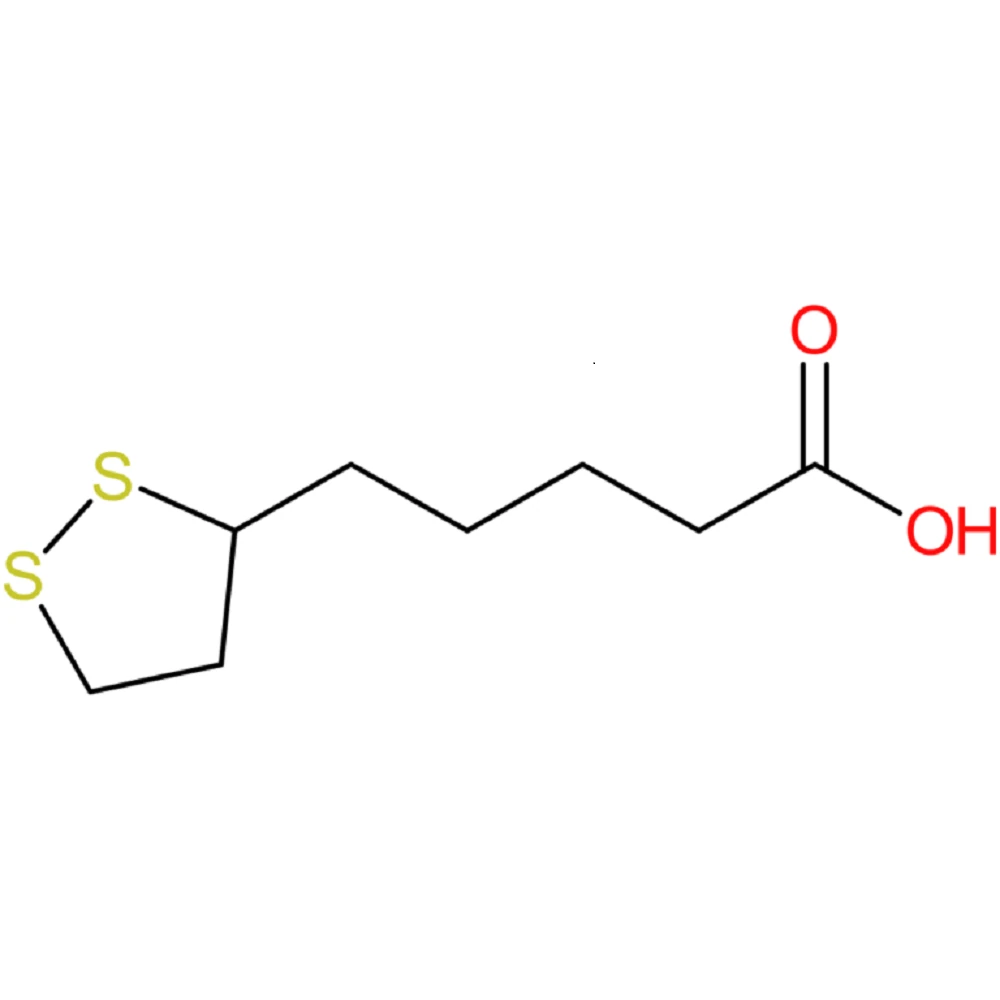
Alpha-lipoic acid is a small molecule with a wide reputation. Its formula, C₈H₁₄O₂S₂, describes a five-carbon chain that ends in a carboxylic acid at one end and closes into a five-membered ring at the other. Two sulphur atoms sit inside that ring, bonded to each other. Molecular weight: 206.32. Almost everything the material does, in a cell or in a drum, starts with that ring.
A Small Ring That Does the Work
The bond between the two sulphur atoms is reversible. Add two hydrogen atoms and the ring opens into dihydrolipoic acid, usually shortened to DHLA; remove them and it closes again. That back-and-forth is the entire mechanism. The pair acts as a two-step electron shuttle, and the reduced form can return electrons to oxidised vitamin C, glutathione, or coenzyme Q10 and set them working again. Inside the body the same ring serves as a cofactor for two enzyme complexes that gate the citric acid cycle. Cells synthesise small amounts; the rest comes from food, mainly organ meats, spinach, broccoli, and yeast.
One detail is worth holding on to. The ring is fragile once it meets heat. Let it open and link to a neighbouring molecule and it does not open back. The result is a polymer: insoluble, darker, unrecoverable. Most of the quality problems described below begin there.
Why One Molecule Behaves Like Two Ingredients
One end is a carboxylic acid that loses a proton near pH 4.7 and prefers water. The other is a sulphur ring that prefers oil. Both statements hold at once, which is why formulators call the material amphiphilic. Water takes up roughly a gram per litre at room temperature; ethanol, acetone, and most triglycerides take it far more readily.
The dual nature cuts both ways. It lets a formulator place the ingredient in an oil phase and still have it partition toward water, which suits emulsions. The same trait makes it migrate — into packaging film, into the oil phase of a cream, through a membrane. Modest water solubility caps what a clear drink can carry, and the acid group means pH decides how much stays dissolved.
Why the Market Mostly Buys the Racemic Form
The dithiolane ring carries a chiral centre. Two mirror forms exist, R and S, and only R occurs in living tissue. Enzyme sites recognise R; S fits poorly. Marketing followed the chemistry, and R became the premium story: natural, better absorbed, effective at a lower dose. None of that is wrong.
Yet most of the tonnage traded is the racemic 1:1 mixture. Price explains part of it. The rest is physical, and it decides whether a lot can run on your equipment at all.
The Melting Point That Decides Your Process
Racemic alpha-lipoic acid melts between 60 and 62 °C. The pure R form melts near 46 to 49 °C. On a data sheet the gap reads like a footnote. Against a process flow it becomes a gate.
Direct compression runs cool, and both grades survive it. Plenty of operations do not run cool: wet granulation followed by a fluid-bed dry, hot-melt granulation, roller compaction with warmed rolls, melt extrusion, or a drying oven set to 60 °C for safety. Add a little moisture, add a little light, and the ring begins to open and link. The racemic grade holds to about 60 °C; the R grade, to about 48. Those degrees are the whole window, and a 60 °C oven sits at one ceiling and past the other.
When your drying step is gentle, R performs well and the extra activity is real value. When the line runs warm, the premium you paid can finish as an insoluble fraction in the blend, invisible on the label and very visible in the product. One question settles more grade decisions than any bioavailability comparison: what is the highest temperature this powder will meet, and for how long.
What the S-Enantiomer Is Actually Doing
The usual summary calls S the useless half, a diluent you pay for. The solid-state picture is less dismissive. S does not drive the redox chemistry attributed to R, yet it changes how the crystal packs, and the mixed crystal is why the racemic grade melts higher and sharper than the pure enantiomer. That higher, tighter melt is what buys heat tolerance, less caking, and a more consistent particle size after milling.
Cell studies hint that the two forms do not simply add up, and that S may dampen some of what R does. Treat that as an open question. The commercial reading stays simple. Choose R when the dose is small, the process is cold, and the label depends on the natural form. Choose racemic when throughput, heat tolerance, and a cost that survives a commodity market matter more. Both choices are defensible. Only one matches a given line.
Reading the Numbers Behind a 98% Figure
An assay says how much of the molecule is present. No two certificates of analysis in this trade carry quite the same set of results. A few further measurements, read alongside the assay, say what kind of 98% you have bought — and two of them you can check yourself within an hour of opening the drum.
Assay: What the 98% Covers and What It Skips
Assay runs by HPLC against an external standard and counts molecules that still carry an intact ring. It says nothing about which mirror form they are, nothing about polymer sitting beside them, nothing about residual solvent. A lot at 98.5% can hold a percent and a half of precisely the material you were trying to keep out.
Melting Range: The Cheapest Identity Test
Ask for two numbers rather than one. A narrow range, 60 to 61 °C for instance, points to a single crystal form with little polymer and little trapped solvent. A range that opens low or spans four degrees points the other way. The test takes minutes, needs no HPLC, and can run on arrival. Drift matters more than any single value, so keep the last three ranges and compare.
Optical Rotation: Only Meaningful When You Ask for It
Racemic material rotates polarised light essentially not at all, and the absence of a rotation figure on such a lot is normal. The R form rotates strongly, well past +90° depending on solvent and concentration. A near-zero figure on a lot sold as R needs explaining. Where a rotation is quoted, read the basis and the solvent with it; a number without those two details compares to nothing.
Insolubles: The Warning That Never Reaches Paper
The polymer limit is in the pharmacopoeia, at two percent, but rarely on the buyer’s sheet, and no assay shows it. Ring-opened polymer does not dissolve, and a small amount scatters enough light to spoil a clear product. Two lots with identical assay can differ here, and only one survives a clarity test.
| Number or test | What to read | What a deviation tells you |
| Assay (HPLC) | 98.0% minimum, single result | Rules out dilution, not polymer or enantiomer. |
| Melting range | 60–62 °C racemic; 46–49 °C for R | Low start or wide span: polymer or solvent. |
| Specific rotation | Near zero racemic; strongly positive for R | Near-zero on an R lot: claim unverified. |
| Insolubles (in-house test) | Clear solution, steady from lot to lot | Persistent haze is ring-opened polymer. |
Four Ways ALA Fails in the Plant
Failures rarely announce themselves at the receiving dock. They surface two steps downstream, when the blend will not compress or the serum turns cloudy, and the drum is already open.
Caking in storage. The powder is not especially hygroscopic, but it is heat-sensitive, and a container left on a summer dock reaches temperatures that soften crystal surfaces. Particles sinter, then fuse. Milling the cake adds heat and makes matters worse, which is why a caked drum is usually rejected rather than saved.
Haze in solution. A small polymer fraction scatters enough light to spoil a clear product. A serum that looked fine at filling turns faintly cloudy within a week, and filtering does not fix the next batch.
Colour drift. Trace iron and copper accelerate oxidation, so a scratch of rust in a blender or a mild-steel scoop can start a change nothing downstream will stop. Pale yellow moves through amber to brown, and the shift does not reverse.
A sharper sulphur note. The material always smells of sulphur. What changes is the quality of the smell: a persistent, pungent note usually tracks with ring opening.
Three checks at goods-in catch most of this before the drum reaches the line:
- Melting range on a fresh sample. Capillary method, two numbers, run in the week the drum lands.
- A clarity check in ethanol. One gram in ten millilitres, held against a lamp; haze that will not clear is polymer, not dust.
- A sealed side-by-side against the retained sample. Same light, same background, same day. Eyes are unreliable across weeks and excellent side by side.
None of this needs new equipment, only the habit of checking a lot before it disappears into the blend.
Matching Grade to Application
Dietary supplements take the largest share, and the requirements there are physical: steady particle size, good flow, few fines, an insoluble figure that stays flat. The racemic grade covers most capsules and tablets. A label claiming the natural R form needs paperwork behind it — rotation, chiral assay, and a process cold enough to deserve the claim.
Cosmetics care about colour and odour before they care about assay. A lot that arrives amber will discolour a serum however the formula is built. Solubility sets the second limit: at roughly a gram per litre, a clear aqueous product near pH 5 or 6 holds very little, so most formulas use an emulsion, an anhydrous base, or a low-pH vehicle where more of the acid stays un-ionised. Grade choice matters less here than lot-to-lot colour, which argues for staying on one grade rather than chasing the cheapest.
In markets where the material is cleared for feed use, buyers compare antioxidant function per unit of cost, and pelleting is the hard part. Steam conditioning pushes mash past 70 °C, well into the range where the ring opens. Added before pelleting, a meaningful share of the activity may not survive; added after, or on a protected carrier, more does. Cost and heat tolerance both point to the racemic grade here.
Pharmaceutical and clinical use raises the documentation bar: tighter melting range, residual solvent limits, elemental impurities, a batch record that can be followed. In a few markets thioctic acid is a licensed medicine for a specific indication, which changes what a buyer may substitute. Where a dossier is on file, the grade is fixed by the registration rather than by price.
A Practical Sourcing Brief for Alpha-Lipoic Acid
Once the process window is settled, sourcing reduces to questions about form, packing, and what can be checked on arrival.
Ouhe Technology supplies alpha-lipoic acid as the racemic grade under CAS 1077-28-7, at 98% purity, as a pale yellow crystalline powder with the characteristic sulphur note. Particle size and bulk density are worth fixing against your own filler or press. A finer cut helps content uniformity; a coarser one helps flow; the difference shows up in the first hour of a trial.
What to Agree Before the Drum Ships
Four points are cheaper to settle in writing than to argue about later. Packing comes first: a light-proof inner liner, with nitrogen flushing if the route is long or the warehouse runs warm. Then the figures you want for the lot actually shipped, rather than a representative value from an earlier season. Retention matters too, because a sealed sample held against that lot is the only reference you will have if a question surfaces six months later. Finally, labelling: batch number, production date, and net weight legible without breaking the seal.
From Trial Batch to Repeat Order
A trial can start at one kilogram, which is enough to push the powder through the exact drying and compression steps used in production. That is the point of a trial — not to confirm the assay, which the supplier already quotes, but to see whether the process holds the melting range and the clarity where they began. A clean result moves the order to drum quantities, then to a pallet schedule. One that drifts is worth a conversation about the lot, and about whether a colder step or a different grade fits better.
Frequently Asked Questions
Is alpha-lipoic acid the same as thioctic acid?
Yes. The two names describe one molecule, C₈H₁₄O₂S₂. European pharmacopoeial texts tend to use thioctic acid, while the supplement trade, especially in North America, uses alpha-lipoic acid and the abbreviation ALA. The racemic form carries CAS 1077-28-7 under either name, which is why buyers should match on the number rather than the label.
What is the difference between R-alpha-lipoic acid and the racemic form?
Chirality, melting behaviour, and cost. The R form is the one found in nature, binds enzyme sites more effectively, and melts near 46 to 49 °C. The racemic form is a 1:1 mixture, melts at 60 to 62 °C, costs less per kilogram, and tolerates warmer processing. Neither is the better raw material in the abstract; one is better for a given process.
Why does my material clump or turn sticky in storage?
Heat and moisture, usually together. Crystal surfaces soften, particles fuse, and the mass sets. Once that happens, milling adds heat and accelerates the ring opening that caused the problem. A drum that stays sealed, cool, and out of the light does not do this. One that sits on a summer dock for a fortnight may.
Can alpha-lipoic acid go into a clear water-based serum?
Only at low levels. Solubility in water sits near one gram per litre, and the carboxylic acid ionises around pH 4.7, so how much stays dissolved depends heavily on pH. Most formulas work around the limit with an emulsion, an anhydrous base, or a low-pH vehicle. Colour is the second risk: a lot that is already amber will tint the finished product.
Is 98% purity enough for a dietary supplement?
Usually, provided the other numbers agree. A 98% lot with a tight melting range, low insolubles, and low moisture behaves well. A 98% lot with a wide range and a rising insoluble figure will cause trouble regardless of the assay. Buy the set, not the headline.
Conclusion
Little about this chemistry is exotic. The molecule has been characterised for decades, and the grades on offer are well known. What still costs buyers money is the distance between a figure on paper and a powder in the drum — between a number that passes and a material that behaves. Four figures read together close most of it: assay for quantity, melting range for integrity, rotation for identity, insolubles for history. One trial kilogram closes the rest.
If you want to test a lot against your own process, ask Ouhe Technology for a sample and the lot data behind it.