News & Insights
Stay informed with the latest breakthroughs, partnerships, and thought leadership from the chemists leading the future of sustainable materials, pharmaceuticals, and advanced manufacturing.
Nicotinamide Mononucleotide (NMN): Properties, Research Uses, and Sourcing Considerations
Nicotinamide mononucleotide, usually shortened to NMN, has become one of the most studied NAD+ precursors in biomedical research. The reason is easy to grasp: it sits one step away from NAD+, a coenzyme that every living cell depends on for energy and repair. This article explains what NMN is, how it works in the body, what researchers use it for, and what buyers should check before adding it to a project.
Key takeaways
- NMN is a nucleotide and a direct building block for NAD+, the coenzyme behind cellular energy and repair.
- NAD+ levels fall with age, which is why NMN attracts so much research interest.
- Only the β form of NMN is biologically active, so purity and isomer control matter in practice.
- The compound is sensitive to moisture and heat, so storage and documentation deserve attention.
- Buyers typically weigh purity grade, certificate of analysis, batch consistency, and supply scale before ordering.
What Is NMN?
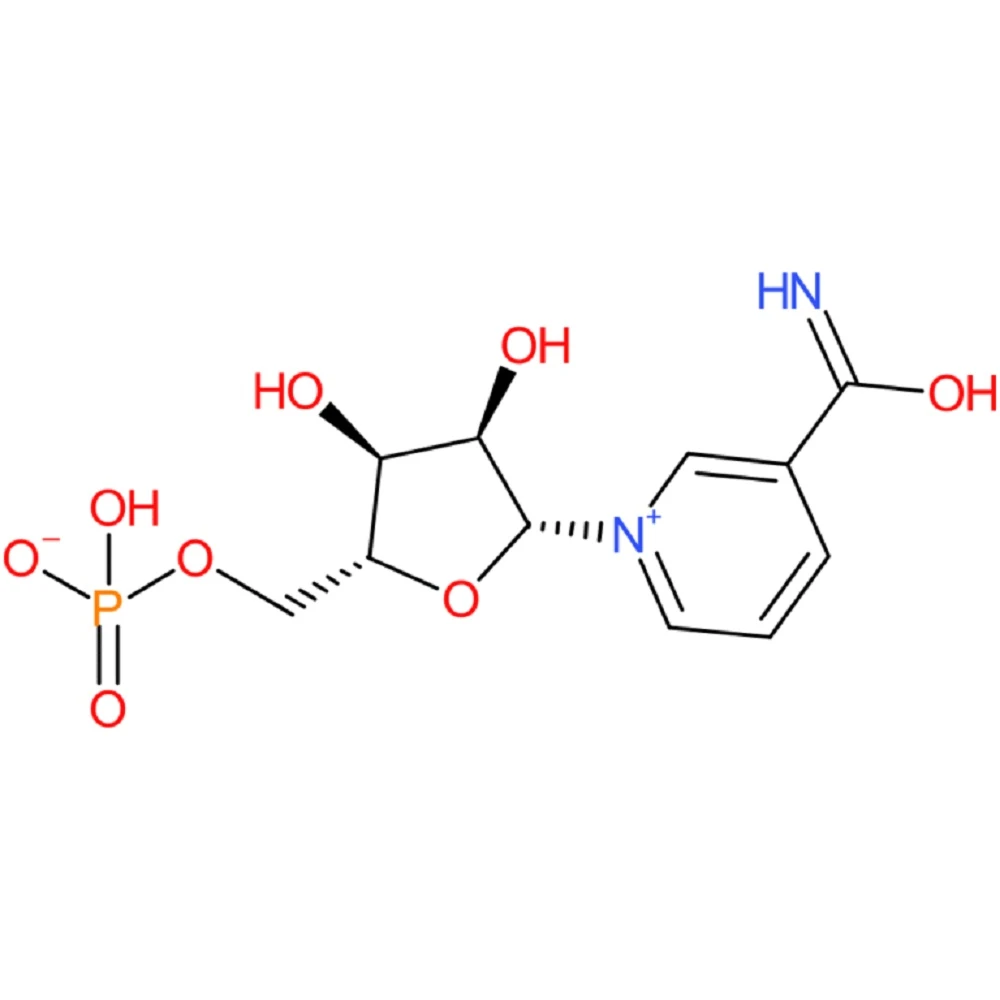
NMN stands for nicotinamide mononucleotide, a nucleotide built from a vitamin B3 derivative and a ribose phosphate unit. Your body produces it naturally, and small amounts also occur in foods such as edamame, broccoli, and avocado. Although the molecule is often discussed together with anti-aging supplements, it is first of all a research chemical with a defined structure and a defined set of physical properties.
A useful way to picture the molecule: think of NAD+ as a rechargeable battery inside each cell, and NMN as the raw material the cell uses to recharge it. The analogy is not perfect, but it captures the core idea, because NMN matters mainly for what the body can make from it.
Its formal name is β-nicotinamide mononucleotide, and the Greek letter matters more than it looks. NMN exists as two mirror-image forms, α and β, and cells only use the β form. A bottle labeled simply NMN is therefore not enough; the active isomer has to be present. The CAS registry number 1094-61-7 identifies the β compound unambiguously, which is why catalogs and purchase orders rely on it.
NMN and NAD+: How the Molecule Works
To understand NMN, you first need to meet NAD+. Nicotinamide adenine dinucleotide is a coenzyme found in every cell, and its workload is enormous: it transfers energy in mitochondria, helps sirtuin proteins regulate gene activity, and feeds the enzymes that repair damaged DNA. The catch is that NAD+ levels decline steadily with age in both rodents and humans, and that decline has been linked to a wide range of age-related changes.
NMN offers one of the most direct routes back. Once inside a cell, the molecule is converted into NAD+ in a single step. That short distance makes it attractive for study: instead of trying to deliver a fragile coenzyme directly, researchers can supply a smaller, more stable precursor and let the cell do the rest. NMN and its relative NR (nicotinamide riboside) both travel this pathway, though they enter at slightly different points. For such a small molecule, the research footprint is unusually large: a growing body of research now examines its effects in cells, animals, and people.
Key Chemical, Physical, and Handling Properties
The table below summarizes the basic data that matters when evaluating NMN for a research or development program.
Table 1. Key chemical and physical properties of NMN
| Property | Value |
| Product name | β-Nicotinamide mononucleotide |
| CAS number | 1094-61-7 |
| MDL number | MFCD00038748 |
| Molecular formula | C11H15N2O8P |
| Molecular weight | 334.22 g/mol |
| Research purity grade | 98% |
| Physical form | Solid powder |
| Recommended storage | Refrigerated, sealed, protected from moisture |
These numbers carry practical weight. The molecular weight guides how stock solutions are prepared, the formula shows exactly which atoms the molecule contains, and the storage note explains why NMN does not behave like a shelf-stable commodity. The compound dissolves readily in water, so most labs prepare aqueous stock solutions without trouble. A quick check of these parameters also helps when comparing quotes from different suppliers, because two bottles with the same name can still differ in grade and handling advice.
How Is NMN Produced?
Inside the body, NMN is assembled from nicotinamide, the amide form of vitamin B3, by an enzyme called NAMPT (nicotinamide phosphoribosyltransferase). A second salvage pathway converts nicotinamide riboside into NMN. Both routes recycle vitamin B3 into fresh NMN, which then feeds NAD+ production.
On an industrial scale, manufacturers follow two broad strategies. Chemical synthesis builds the molecule from sugar and phosphate building blocks, while enzymatic methods use enzymes to join the pieces under milder conditions. Enzymatic routes have become popular because they produce the biologically active β form selectively and leave fewer impurities behind. Until recent years NMN was a niche research item; today dedicated fine-chemical producers supply it in kilogram quantities, because demand from labs and formulators keeps growing. Whatever the route, the final steps are purification and rigorous analysis, since trace impurities can skew biological assays in ways that are hard to trace.
Research Applications of NMN
Interest in NMN spans several fields, and the common thread is NAD+ biology. The sections below cover the areas where the molecule appears most often.
Aging and longevity research
NAD+ restoration sits at the heart of this field. Studies in rodents have reported that NMN raises NAD+ levels in tissues and improves markers tied to metabolism, muscle function, and DNA repair. Human trials are smaller and more recent, but several have confirmed that oral NMN can raise NAD+ levels in blood, and long-term questions remain open.
Metabolic and energy research
Because NAD+ sits at the center of energy metabolism, NMN appears in studies of insulin sensitivity, mitochondrial function, and exercise physiology. Researchers use it as a tool to ask what happens when NAD+ supply is no longer the limiting factor, whether in isolated cells, animal models, or human volunteers.
Nutrition, cosmetics, and formulation R&D
NMN also shows up in the development of dietary supplements, functional foods, and cosmetic actives. Formulators care about the same variables as biologists — purity, isomer content, and stability under storage — and the differences between oral delivery, topical use, and cell-culture work shape how the material is packaged and tested. Because finished products face different rules in different markets, formulators often start with a well-documented raw material and confirm local requirements before launch.
Sourcing High-Purity β-Nicotinamide Mononucleotide: What to Look For
Once a project moves from idea to ordering, the questions change. Which grade should I buy? How do I know the batch matches the label? Can the supplier deliver the quantity I need? The points below walk through what experienced buyers check before committing.
Purity, identity, and the isomer question
A document alone does not make a chemical suitable for research; the values on it do. For β-Nicotinamide mononucleotide, buyers should confirm three things: the CAS number, the stated purity, and analytical evidence such as NMR or HPLC data that the batch matches the label. High-purity material — the 98% grade offered for research use, for example — reduces the risk that an unexpected impurity, rather than the molecule itself, explains a puzzling result. Because only the β form is active, an isomer check matters just as much as a percentage.
Storage and stability
NMN is not a forgiving compound. Moisture and heat accelerate degradation, so the standard advice is to keep it refrigerated and sealed until use. Brief handling at room temperature is normally acceptable, but leaving the bottle open on a bench is a known source of trouble. Ask how the material is packed and what stability data the supplier holds, then match your own handling to it.
Documentation and quality control
Reputable suppliers back every lot with paperwork: a certificate of analysis listing the purity and the analytical methods used, plus safety data sheets for handling and shipping. Batch consistency matters just as much, especially when a study runs for months or a formulation moves from grams to kilograms. ISO-certified processes and experience with cross-border chemical logistics make it easier to get both the documents and the delivery right.
From grams to kilograms
NMN is ordered in quantities that range from single grams for assay development to multi-kilogram lots for pilot production. Many teams also ask for a small sample first, because a gram-scale order lets them verify purity and handling before committing to a larger lot. A supplier that stocks the compound and ships internationally smooths the transition, since the same grade, documentation, and handling protocol apply at every scale. For current availability, certificates, and pricing on β-Nicotinamide mononucleotide, contacting the OUHE Chem team with your target quantity and purity is the fastest route to a concrete answer.
Frequently Asked Questions
What is the difference between NMN and NR?
Both molecules are NAD+ precursors, but they enter the pathway at different points. NR (nicotinamide riboside) is converted into NMN inside the cell, which is then converted into NAD+. NMN skips that first step. In practice, researchers compare the two because they differ in transport, dosing, and published evidence, and neither is better across the board.
Is NMN the same as vitamin B3?
Not quite. Vitamin B3 covers several forms, including niacin and nicotinamide. NMN is a downstream product built from nicotinamide, so it is related to the vitamin but chemically distinct. The body makes NMN from B3 and then converts it into NAD+.
Why does purity matter when buying NMN for research?
Biological experiments are sensitive to small amounts of unexpected material. Residual solvents, related nucleotides, or the wrong isomer can change results without being obvious. A documented purity grade, confirmed by analysis, gives researchers a reliable starting point.
How should NMN be stored?
Keep it refrigerated and sealed, away from moisture and light. Short handling times at room temperature are normally fine, but long-term storage on an open bench is not recommended. Follow the storage advice on the container or certificate.
What should a buyer check before placing an NMN order?
Start with identity and grade: the CAS number, the stated purity, and the analytical evidence behind it. Then confirm packaging and storage requirements, ask for the certificate of analysis, and check that the supplier can handle your required quantity and destination. Those four checks cover most sourcing surprises.
Conclusion
NMN has earned its reputation in the lab, not as a miracle substance, but as a clean way to study NAD+ biology. It is a small nucleotide with a clear structure, a well-defined CAS number, and a growing body of research behind it. Whether the goal is basic aging research, metabolic studies, or product development, the practical details — purity, isomer, storage, and documentation — decide how useful the material really is.
If you are planning NMN experiments or formulation work, contact the OUHE Chem team with your target quantity and purity to receive documentation and a quote.