News & Insights
Stay informed with the latest breakthroughs, partnerships, and thought leadership from the chemists leading the future of sustainable materials, pharmaceuticals, and advanced manufacturing.
Berberine Chloride (CAS 633-65-8): Salt Form, Water Content, and What a Purity Figure Really Means
Key takeaways
- Berberine chloride is the salt form of a yellow isoquinoline alkaloid, and the form most buyers specify.
- Commercial material is usually a dihydrate, so close to a tenth of its weight is water before any impurity is counted.
- A 98% assay is normally calculated on the anhydrous basis, which means two powders carrying the same figure can deliver different amounts of active per kilogram.
- Titration and chromatography answer different questions about the same batch, and a useful certificate says which one produced the number.
- Palmatine and jatrorrhizine are the impurities worth tracking, because they come out of the plant alongside berberine.
What Berberine Chloride Is
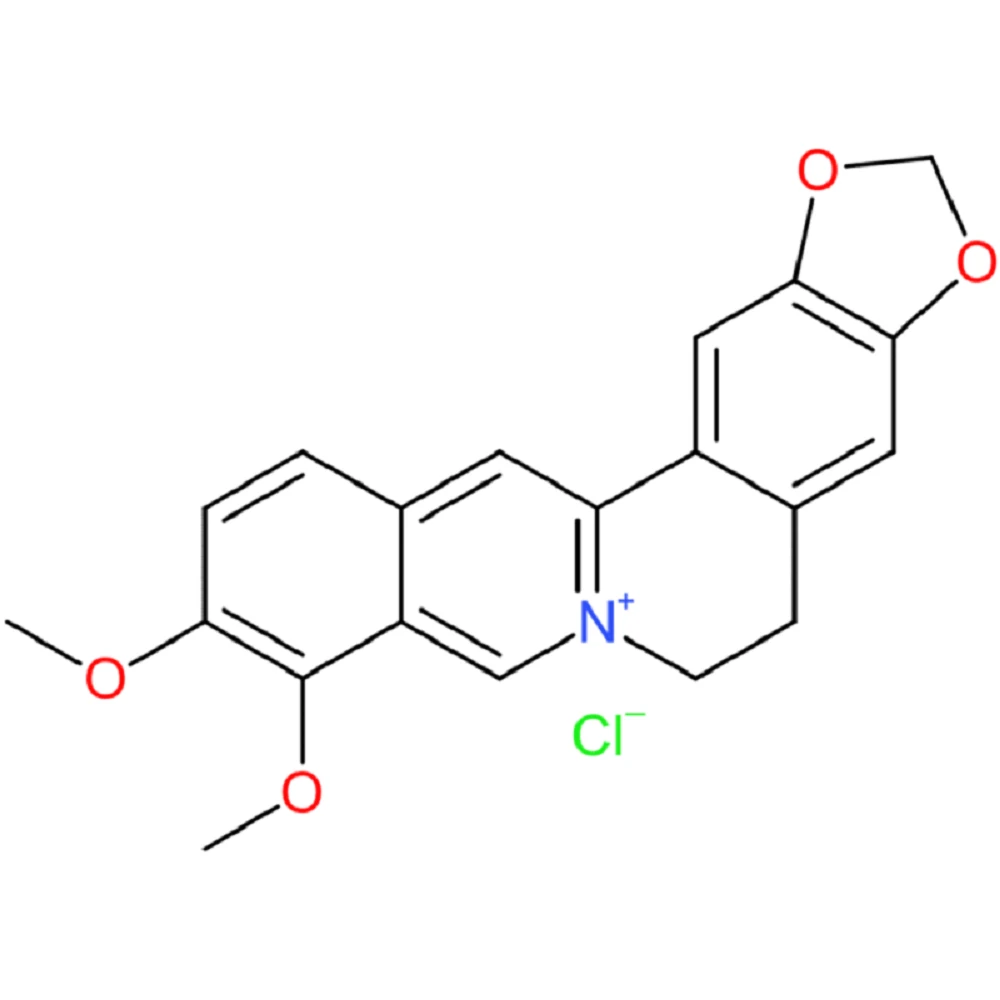
Berberine is a yellow alkaloid built on a four-ring isoquinoline skeleton. It occurs in the roots and stem bark of Chinese goldthread (Coptis chinensis), in Phellodendron bark and in several barberry species, which is why the same molecule reaches buyers under a handful of plant names and trade names.
The detail that shapes everything downstream is the nitrogen. In berberine it carries a permanent positive charge, a quaternary ammonium center that no change in acidity can neutralize. Ordinary amines switch between charged and uncharged forms as pH moves, so their solubility follows the surrounding liquid. Berberine does not behave that way, and a formulator who expects amine-like behavior will be caught out by it.
The free base is awkward to handle on its own. Pairing the cation with hydrochloric acid gives Berberine Chloride, a crystalline yellow solid that mills, blends and dries with reasonable predictability. That salt is what most manufacturers buy, and CAS 633-65-8 identifies it without ambiguity. Anhydrous, it weighs 371.82 g/mol; two water molecules add roughly 36 g/mol more, and that difference reappears later in every price calculation.
In the drum it looks ordinary: a yellow to orange-yellow crystalline powder, sometimes with a faint green cast. Two of its properties are less ordinary. The taste is violently bitter and registers far below the concentration where a flavor system would normally be needed. Under ultraviolet light the powder glows yellow-green, which allows a quick identity check with nothing more than a UV lamp.
Supply arrives from two directions. Solvent extraction pulls berberine out of plant material; semi-synthesis starts from an isolated base and forms the salt in a controlled step. Buyers come from supplement manufacturing, functional beverages, cosmetics, research laboratories and animal nutrition, and each group reads a different part of the certificate.
What a 98% Figure Really Means
Almost every quotation for this material carries a purity figure, and almost none of them say what the figure measures. One number is doing the work of three separate measurements, which is where comparison starts to go wrong.
The assay needs a method
Two methods dominate. Non-aqueous titration measures how much berberine cation the sample contains, and the result is usually calculated on the anhydrous substance, with water and inorganic residue excluded first. High-performance liquid chromatography separates the components and reports the area share of the berberine peak. A batch can read 98.0% by titration and 97.2% by chromatography without either value being false. A certificate that names its method is worth far more than one that does not.
Water is either counted or it is not
Commercial berberine chloride usually crystallizes as a dihydrate, and a fully hydrated crystal carries close to 9% water by weight. Karl Fischer titration on real batches tends to land between 8% and 12%, because surface moisture sits on top of the crystal water. Put the two facts together and the arithmetic explains a lot of quiet disagreement. A powder quoted at 98% on the anhydrous basis, carrying 10% water, delivers about 88 kg of berberine chloride in every 100 kg shipped. A second supplier quoting the same figure with 6% water delivers 92 kg. Across a full shipment that gap decides the price, not the wording on the quotation. Comparing offers on a dry basis makes the difference visible in one step.
Impurities travel with the molecule
Berberine rarely arrives alone. Palmatine and jatrorrhizine share its biosynthetic pathway and behave similarly in solvent, so they follow it through extraction and show up early in a chromatogram. How much survives depends on the plant source and on how many purification steps the material has seen. A semi-synthetic route begins from a purified base and can reach lower related-substance totals than a short extraction sequence, although it raises its own questions about process residues.
Table 1. The parameters worth reading, what each one tells you, and the figures the trade usually quotes for them.
| Parameter | Typical trade range | What it tells you |
| Assay by titration, anhydrous basis | 97-99% | how much berberine cation the batch contains |
| Assay by HPLC | 97-99% area | share of the main peak after separation |
| Water, Karl Fischer | 8-12% | share of the shipment that is water |
| Palmatine | not more than 1.0% | co-extracted alkaloid |
| Jatrorrhizine | not more than 0.5% | co-extracted alkaloid |
| Residue on ignition | not more than 0.2% | inorganic salts left after burning |
| Heavy metals | not more than 10-20 ppm | raw material and equipment cleanliness |
What It Does in a Formulation
Once the powder leaves the warehouse, three properties decide how it behaves: taste, color and solubility.
Bitterness comes first. Berberine tastes bitter at concentrations so low that a sweetener cannot cover it, and the sensation lingers. Capsules and coated tablets sidestep the problem entirely. Gummies, effervescents and ready-to-drink formats cannot, and masking them usually takes more than a top note of flavor.
Color is equally stubborn. The yellow is intense and it stains, so a sieve, a press tool or a bench left with powder on it keeps a mark long after cleaning. Whether that matters depends on the dosage form. In a white tablet it matters a great deal.
Solubility is where the surprises hide. Cold water takes up little of the salt, hot water takes up a good deal, and a clear beverage that is fine while warm can throw crystals as it cools. Ethanol dissolves only a small amount, which limits the alcohol-based formats that work well for other botanical extracts. Drying and milling add a quieter cost as well. The powder holds moisture stubbornly, and a process that over-dries it to hit a number creates dust, static and caking further down the line.
- Dissolve in the hot phase, then check clarity once the batch cools. A solution that clouds on cooling will not stay clear on a shelf.
- Treat acidity as irrelevant to solubility but not to color. Strongly alkaline conditions are where the yellow starts to shift.
- Store sealed, cool and out of light. The powder takes up moisture readily and does not give it back.
- Keep milled material off shared equipment unless the next batch can tolerate a yellow tint.
Sourcing: What to Check Before You Order
Most disappointments with this material are documentation problems rather than chemistry problems. Three checks catch nearly all of them.
Ask for the basis, not just the number
Request the assay together with its method and its basis, then ask for water content on the same document. Without both, the figure cannot travel: it cannot be compared with a competing quotation, and it cannot be converted into kilograms of active material.
Ask which impurities are limited
Palmatine and jatrorrhizine limits, residue on ignition, heavy metals and residual solvents are the lines that separate a food-grade powder from a research-grade one. Reading them takes a minute and shows how much purification the material has seen.
Sample first, then confirm what ships
A kilogram settles questions no document can answer. How the powder flows, how bitter it is at your dose, whether your drying step loses yield. Material supplied by OUHE is offered at 98% purity, so ask for a sample and confirm that the grade tested matches the grade shipped. Packaging deserves a question of its own: a drum with a double liner and a desiccant is the usual arrangement, and it is the one to insist on if the material will sit in storage for months.
Frequently Asked Questions
Is berberine chloride the same as berberine hydrochloride?
Yes. The two names describe the same salt, and both map to the same registry number. Suppliers use them interchangeably, and quotations, labels and catalogs mix them freely. When comparing offers, match the number rather than the label.
Why do two suppliers quoting 98% give different results?
Because the figure is calculated on different bases and produced by different methods. One may report titration on the anhydrous substance, another chromatography on the material as shipped. Ask for the method and the water content before drawing a conclusion.
How much water should the powder contain?
Dihydrate material sits around 8% to 12% by Karl Fischer titration. Values well below that suggest the batch has been over-dried; values far above it point to surface moisture that will cause caking in storage.
Does it dissolve in water?
Sparingly in cold water, readily in hot water, and only slightly in ethanol. The salt carries a permanent charge, so acidity does not change how much dissolves. In a beverage the risk is crystallizing during cooling rather than refusing to dissolve at all.
Is dihydroberberine a better choice?
Dihydroberberine is a reduced form that converts back to berberine once absorbed, and it is taken up more efficiently in animal studies. It solves an absorption problem rather than a manufacturing one, and it costs considerably more. For most formulation work the chloride remains the practical starting point.
Conclusion
Berberine chloride looks like a commodity on a quotation sheet: a yellow powder, a percentage, a price per kilogram. The chemistry underneath is more interesting than that, and most of the practical difficulty sits in the gap between the number and what it measures. Water content, assay method and related substances decide how much active material actually arrives, and they decide it long before anyone opens the drum.
Buyers who ask for the basis, the method and the impurity limits get a powder they can formulate with. Buyers who compare percentages alone get a surprise at the blender. If you are evaluating berberine chloride for a supplement, beverage or research program, contact the OUHE team with your target quantity and purity to receive batch documentation and a quotation.