News & Insights
Stay informed with the latest breakthroughs, partnerships, and thought leadership from the chemists leading the future of sustainable materials, pharmaceuticals, and advanced manufacturing.
Curcumin (CAS 458-37-7): Why One Molecule Behaves Differently from Turmeric Extract
Key takeaways
- Curcumin is one defined molecule, whereas turmeric extract is a mixture that carries several closely related pigments.
- A figure such as 95% total curcuminoids and one that measures individual curcumin do not describe the same thing, so buyers cannot compare them side by side.
- The β-diketone core explains three everyday headaches at once: the powder barely dissolves in water, its colour changes with pH, and it breaks down under light or in alkaline conditions.
- Since the pigment is intense and stains equipment, formulators usually settle dispersion, pH and packaging before they settle dosage.
- A single-compound grade keeps analytical work simple, provided the assay basis and the documents behind each lot are clear.
What Curcumin Actually Is
One compound, not a plant extract
Most people meet curcumin through turmeric, the yellow spice ground from the rhizome of Curcuma longa. That is where the confusion begins. When a chemist says curcumin, they mean one particular substance with a fixed formula and a fixed molecular weight. When a buyer sees turmeric extract on a quotation, they are looking at a mixture that still carries plant fibre, oils and a family of related pigments.
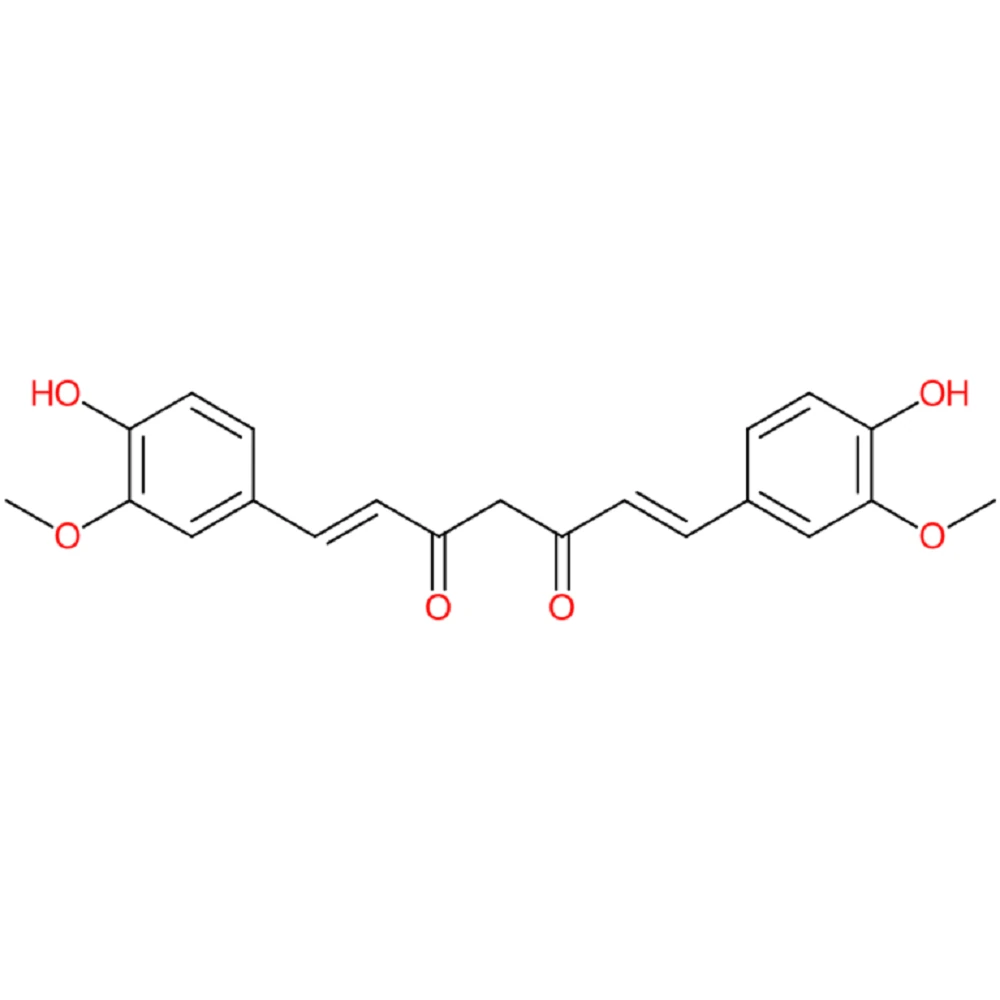
Turmeric makes three of these pigments together, and chemists call the group curcuminoids. Curcumin is the largest fraction, usually somewhere near three quarters of the total. Demethoxycurcumin contributes roughly a fifth, while bisdemethoxycurcumin makes up the small remainder. Each differs only by the number of methoxy groups attached to the aromatic rings, yet that small difference changes how each one dissolves, absorbs light and behaves in an assay.
This matters in trade because the two labelling habits overlap. Someone can quote 95% total curcuminoids, which adds all three pigments together. Someone else can quote a single-compound assay, which measures one peak after chromatographic separation. Both numbers can be honest. You cannot convert one into the other without knowing what was measured. A reader who treats them as equivalent will misjudge both the dose and the price.
What the structure tells you
Hold the structure up and the behaviour starts to make sense. Two aromatic rings sit at either end of a seven-carbon chain. Each ring carries a phenol group and a methoxy group, and the middle of the chain holds a β-diketone: two carbonyl groups separated by one carbon, flanked by conjugated double bonds. Chemists call this a diarylheptanoid, and the older name diferuloylmethane describes the same skeleton.
That long conjugated path is why the powder is so vividly yellow. It absorbs visible light efficiently, and it also gives the molecule room to shift electrons around. The phenol groups donate hydrogen atoms, which explains the antioxidant activity researchers study. The β-diketone in the middle causes more trouble. It can rearrange between a keto form and an enol form, and the balance between them responds to pH. Nearly every practical quirk in the next section traces back to this one flexible centre.
Once you see the molecule this way, the trade names stop being confusing. Turmeric powder, a standardised extract and a purified single compound are three materials at three different stages of separation, even though shop labels often use the word curcumin for all of them.
Core Physical and Chemical Parameters
Table 1. Physical and chemical values that describe the curcumin molecule itself.
| Parameter | Typical value | What it tells you |
| Molecular formula | C₂₁H₂₀O₆ | One defined molecule, not a mixture |
| Molecular weight | 368.385 g/mol | Basis for molar calculations in assays |
| CAS registry number | 458-37-7 | Unambiguous identity across naming habits |
| Melting point | about 183 °C | Useful as a rough identity check |
| Water solubility | practically insoluble | Aqueous systems need a dispersion strategy |
| Soluble in | ethanol, DMSO, acetone, ethyl acetate | Which working solvents suit a stock solution |
| log P | roughly 2.3-3.2 | Confirms the hydrophobic character |
| Colour versus pH | yellow in acid and neutral, orange-red in alkali | A visible warning when pH drifts |
| Stability | sensitive to light and to neutral-alkaline conditions | Why storage and packaging deserve attention |
Values in this range describe the molecule itself. They give a formulator a starting point, although the behaviour of any single batch still depends on how it was made and stored.
Why Curcumin Behaves the Way It Does
Why water will not take it up
Anyone who has tried to stir the powder into a glass of water has seen the result: it wets poorly, floats, and leaves a yellow ring on the vessel. The reason is simple. The two aromatic rings and the conjugated chain are largely non-polar, and the phenol groups cannot compensate for that. A log P between roughly 2.3 and 3.2 puts the molecule firmly on the lipid-loving side, so water has little to hold on to.
Researchers work around this by choosing a solvent first. Ethanol, DMSO, acetone and ethyl acetate all dissolve it readily, which is why stock solutions for cell work start in an organic solvent. In a factory the choice is harder, since a beverage or a cream cannot simply be dosed with DMSO. In that setting, formulators reach for emulsions, lipid phases, phospholipid complexes or encapsulation, so that the pigment is dispersed rather than dissolved. A clear drink that looks fine at first often throws a sediment later, because dispersion is not the same as solution.
Heat does not rescue the situation. Although warm water takes up slightly more than cold, the gain is too small to build a process on, and raising the temperature also speeds up degradation.
Why the colour shifts with pH
The β-diketone in the middle of the chain can exist in two forms. In acidic and neutral media the keto form dominates, and the material looks yellow. As conditions become alkaline, the enol form takes over; the phenolic part of the molecule loses a proton, the conjugated system changes, and the colour moves through orange to a deep red. A researcher who has watched a yellow solution turn red after a careless pH adjustment has seen this equilibrium firsthand.
The colour change is more than a curiosity, because it signals a stability problem as well. The enol form is chemically more fragile. In neutral to alkaline aqueous solutions curcumin can lose a large share of the parent compound within half an hour, breaking into smaller fragments that include vanillin and ferulic acid. Acidic conditions keep it comparatively stable. So a formulator who needs a neutral or slightly alkaline base has to think about pH from the start, not after the colour has already moved.
This also explains a common complaint in finished goods. A product that leaves the plant the right shade can fade or brown on the shelf, especially when the package lets light through and the formula sits near neutral pH.
Why light and alkaline conditions matter
Light attacks the same conjugated system that gives curcumin its colour. Even ordinary daylight causes measurable loss, and workers can reduce it simply by choosing amber glass or opaque packaging instead of clear containers. Heat and dissolved oxygen add to the effect, so a warm filling line and a long holding time both shorten the useful life of a batch.
None of this makes the material difficult to buy. It makes it worth handling with a plan. Most of the practical rules follow directly from the chemistry above:
- Choose the dispersion route before you fix the dose. Whether you use a lipid phase, an emulsion or an encapsulated form decides how much of the powder the finished product can carry.
- Measure and hold the pH of the finished base. A drift towards alkaline conditions changes both colour and assay, and it tends to show up only after storage.
- Keep the powder and the finished batch out of strong light. Amber or opaque packaging costs little compared with a reformulation.
- Expect the colour to travel. The pigment stains sieves, presses and bench surfaces, so schedule it before a cleaning step or dedicate the equipment.
Where Curcumin Shows Up in Formulations
Dry formats came first, and for good reason. Capsules, tablets and powder blends ask the least of a material that refuses to dissolve in water. A capsule also hides the colour and the faint bitter note, so manufacturers can work with the pigment without redesigning the whole product around it. Once the powder is blended into a dry premix, its intense colour actually helps: a technician can see at a glance whether the mix is even.
Liquid formats demand more patience. A clear beverage has nowhere to hide a suspended yellow solid, and a drink that passes on the filling line may throw a sediment three weeks later. Emulsions, lipid carriers and encapsulated forms all help, although each adds a step and a cost. This is why curcumin appears far more often in powders, oils and softgels than in a transparent drink. Anyone developing a water-based product should test the full shelf life rather than judging the sample on day one.
Two smaller uses deserve a mention. Cosmetic chemists value the antioxidant story but fight the staining, since a white cream picks up a yellow cast almost immediately. Analytical teams sit at the other extreme: they want one defined molecule with a clean chromatographic profile, because a standard or a tool compound is only useful when a single peak means exactly one substance. Both groups end up asking the same question, namely how much of the other two curcuminoids remains in the material.
A Defined Grade for Research and Formulation Work
Curcumin (high purity) as a single-compound grade
When an assay needs one peak rather than a group of them, Curcumin (high purity) is the grade to ask for. Its identity is fixed by 458-37-7, and the molecule carries the formula C₂₁H₂₀O₆ with a molecular weight of 368.385 g/mol. OUHE supplies it under the reference MDL MFCD00008365 and the item number A31829; the material is kept frozen and sealed. For a laboratory that prepares its own stock solutions, this is the useful part of a defined grade: one molecule, one formula, one molecular weight, so molar calculations and chromatographic comparison stay straightforward.
OUHE offers this grade at 98% purity. A buyer who sets that number beside a 95% total-curcuminoid offer should first establish what each assay measured, since a single-compound value and a combined fraction are not interchangeable. Once the basis is clear, researchers who need to isolate one variable in a pathway assay can work from a single defined molecule rather than a mixture. That clarity comes at a price, and a broader extract costs less per kilogram.
What to confirm before material ships
Before a drum moves, buyers can settle a few points in writing. OUHE can provide a certificate of analysis, a safety data sheet and technical data for the lot on request, so ask which method produced the assay and whether the figure covers the individual compound. Packing deserves its own line: the powder stains, it takes up moisture, and it degrades in light, so a sealed, light-proof inner liner is a reasonable request for a long route.
Where a programme grows from bench work to pilot quantities, OUHE also handles custom synthesis and scale-up, and supports export shipments with the usual packing and documentation. If you start with a trial quantity and check it against your own process, you will learn more than any set of figures on paper can show: how the powder flows, how it disperses in your base, and whether the colour holds through your filling step.
Frequently Asked Questions
Is curcumin the same as curcuminoids?
No. Curcumin is one molecule. Curcuminoids is the name for a small family of three related pigments that occur together in turmeric: curcumin, demethoxycurcumin and bisdemethoxycurcumin. A label that quotes total curcuminoids adds all three, whereas a single-compound grade measures only the first.
What is the molecular formula of curcumin?
C₂₁H₂₀O₆, with a molecular weight of 368.385 g/mol. Chemists also call it diferuloylmethane, and the structure belongs to a class known as diarylheptanoids.
Why does curcumin not dissolve in water?
Because the molecule is mostly non-polar: two aromatic rings joined by a conjugated chain, with only two phenol groups to interact with water. It dissolves readily in ethanol, DMSO and acetone instead. In water-based products formulators use emulsions, lipid carriers or encapsulated forms to disperse it.
Why does curcumin turn red in alkaline conditions?
The β-diketone at the centre of the chain shifts from a keto form to an enol form as pH rises, and the phenolic group loses a proton. The change alters how the conjugated system absorbs light, so yellow turns orange and then deep red. It also marks a stability risk, since the enol form breaks down faster.
Is curcumin suitable for clear or water-based products?
Rarely in its plain form. The pigment is almost insoluble in water and intensely coloured, so a clear beverage tends to cloud or settle, while a white cream picks up a yellow cast. Dispersion systems help, but they need testing through the full shelf life rather than a check on the day of filling.
Conclusion
Curcumin is not a difficult chemical because it is exotic; it is difficult because one flexible β-diketone sits at the centre of a highly conjugated, strongly coloured molecule. That single feature explains why the powder refuses to dissolve, why its colour moves with pH, and why light and alkalinity shorten its life. Once buyers see those three effects as consequences of one structure, most formulation decisions stop being guesswork.
The same logic clears up the paperwork. A single compound and a total-curcuminoid fraction are different materials, and anyone who compares their percentages without checking the assay basis will draw the wrong conclusion. Ask what was measured, ask how the lot was packed, and run a trial against your own process before you commit to volume.
If you are evaluating a high-purity single-compound grade for a formulation or an assay, contact OUHE with your target quantity and the grade you need to request batch documents and a quotation.