News & Insights
Stay informed with the latest breakthroughs, partnerships, and thought leadership from the chemists leading the future of sustainable materials, pharmaceuticals, and advanced manufacturing.
Resveratrol (CAS 501-36-0): The Trans Isomer, the Assay Basis, and What 98% Really Means
Key takeaways
- Resveratrol is one defined molecule, yet the word on a label can point to quite different materials.
- The trans isomer and the cis isomer share a formula but behave differently in a formulation and in an assay.
- A figure such as 98% only means something once you know what was measured: trans resveratrol, total resveratrol, or a glucoside.
- Light and heat slowly convert trans into cis, so opaque packing and a retest date matter as much as the release number.
- Buyers who fix the assay basis and the impurity limits in writing avoid most of the usual surprises.
What Resveratrol Actually Is
Most people first meet resveratrol in a glass of red wine or along a supplement aisle. In chemistry the word is far narrower. It names one small polyphenol with the formula C14H12O3 and a molar mass of 228.247 g/mol. Plants produce it when they are under stress, and grapes, berries, peanuts and the roots of Japanese knotweed count among the best known sources. A supplier works with the isolated compound rather than with the plant material, which is the first distinction worth making.
One molecule, two shapes
Two geometric forms of this molecule exist. The trans form carries its two aromatic rings on opposite sides of the central double bond. The cis form places them on the same side. Both share the same formula, yet their shapes lead to different behaviour in a capsule, a cream or a test tube. Research has concentrated on the trans form, and trade follows that habit. When a buyer reads the name on a sheet of paper, the trans isomer is normally what is meant.
A short structural picture helps here. Imagine two benzene rings joined by a two-carbon bridge, with three hydroxyl groups scattered across the rings. That arrangement explains why the compound belongs to the stilbene family and why it behaves like a polyphenol. It also accounts for the poor water solubility that later shapes every formulation decision.
Regulation adds another layer. In the European Union, resveratrol made by certain production routes is authorised as a novel food, and each entry carries its own conditions. Anyone placing material into a regulated market should confirm the route and the supporting documents before an order is placed. The molecule may be identical from one source to the next; the paperwork rarely is.
Core Physical and Chemical Parameters
A few numbers do most of the work when a buyer screens a new lot. They describe the molecule itself and the grade most often traded, and they give a formulator a starting point. The behaviour of a particular batch still depends on how it was made, packed and stored.
Table 1. Values that describe the resveratrol molecule and the commonly traded high-purity grade
| Parameter | Typical value | What it tells you |
| Molecular formula | C14H12O3 | One defined molecule, not a plant extract |
| Molecular weight | 228.247 g/mol | Basis for molar calculations |
| CAS registry number | 501-36-0 | Unambiguous identity across naming habits |
| Common high-purity assay | 98% trans by HPLC | The figure most buyers compare |
| Appearance | White to off-white powder | A quick visual check at goods-in |
| Water solubility | Practically insoluble | Aqueous formats need a dispersion plan |
| Soluble in | Ethanol, DMSO, acetone | Practical solvents for a stock solution |
| Light stability | Trans converts to cis under UV | Opaque packing protects the assay |
| Storage | Frozen and sealed | Limits isomer drift over time |
Why the Trans Isomer Does Not Stay Put
Buyers often treat purity as a fixed number. With resveratrol it is closer to a moving target, because the molecule itself changes shape under quite ordinary conditions. Understanding that change turns a confusing certificate into a readable one.
Light, heat and pH as the triggers
Ultraviolet light supplies the energy needed to flip the double bond, so a portion of the trans material becomes cis. Heat speeds that change, while alkaline conditions make it worse. Acidic, cool and dark conditions slow it almost to a halt. None of this makes the compound hard to buy. It makes it worth handling with a plan.
The practical consequence is easy to state. A lot that left the plant at 98% trans can reach a warehouse with a lower figure if it travelled in clear containers or sat near a window. The label has not been falsified; the chemistry has moved on. A release number alone therefore cannot describe what arrives at the door.
What this means for packaging and retest dates
Opaque, sealed packing is the cheapest insurance available. Many suppliers flush the container with nitrogen so that oxidation and isomer drift stay low through shipping. A retest date gives buyers a second anchor, because it states how long the material remains inside the agreed limits.
Two habits save time later. First, use older stock before newer stock. Second, check the assay again when a lot approaches its retest date, especially once the drum has been opened. These steps cost very little and prevent a slow, invisible loss from reaching production.
Reading the Assay: Trans, Total and Polydatin
Two powders can carry the same headline number and still be different materials. The reason lies in what that number actually counts, and the difference shows up in both price and performance.
Trans versus total
A certificate that names trans resveratrol measures one isomer. A certificate that reports total resveratrol adds trans and cis together. A third variation reports total stilbenes, a wider family that includes related compounds. The three figures cannot be swapped for one another, even when all of them are honest.
Ask which method produced the figure and whether cis was reported separately. High performance liquid chromatography with UV detection near 306 nm separates the isomers cleanly, so a supplier who can show both peaks has done the work properly. A single combined figure leaves room for doubt, and that doubt grows during storage.
The polydatin conversion trap
Polydatin, also called piceid, is resveratrol with a glucose group attached. Its molar mass sits near 390 g/mol against 228 g/mol for the aglycone. A lot sold as 98% polydatin therefore delivers roughly 57% resveratrol on an equivalent basis. Comparing that price with a high purity trans offer without converting first will make the wrong choice look cheap.
The rule is straightforward. Put every offer on the same basis before comparing numbers, then write that basis into the purchase order. Doing so removes an argument that otherwise returns at every renewal.
What to confirm before a lot is accepted
- The marker compound named as trans resveratrol, not a combined total
- The assay method and the detection wavelength
- The botanical source or the production route
- A limit for emodin where knotweed is the source
- Heavy metals, residual solvents and microbial counts
- Lot number, production date, retest date and packing type
Emodin deserves a brief note. It is an anthraquinone that occurs naturally in knotweed root. Purification removes most of it, and a stated limit keeps the remainder visible. Fermentation and synthetic routes take a different path, although each brings its own process residues to check.
Where Resveratrol Shows Up in Formulations
Dry formats are the easiest fit. Capsules and tablets ask little of a powder that refuses to dissolve in water, and a hard shell hides the colour and the faint bitter note. Once the dose is fixed, fill weight can be planned straight from the assay. That is the main reason high purity material dominates this part of the market.
Liquid formats take more patience. A clear drink has nowhere to hide a suspended solid, and a sample that looks fine on day one can throw a sediment three weeks later. Emulsions, liposomal carriers and cyclodextrin complexes all help, although each adds a step and a cost. Cosmetic chemists face a related problem, since the powder disperses into oils more readily than into water based creams.
Stability testing should mirror the real format. A powder in a foil sachet and the same powder suspended in a clear bottle age at very different rates, so a shelf life proven for one cannot simply be copied to the other. Analytical laboratories sit at the far end of the range. They want one clean peak, because a reference compound is only useful when a single signal means a single substance. For that group, a defined molecule matters more than a low price.
A Defined Grade for Research and Formulation Work
Projects that need one molecule rather than a botanical mixture ask for a defined grade. That is where a high purity offering earns its place, provided the documents behind each lot are clear.
A high purity grade for measured work
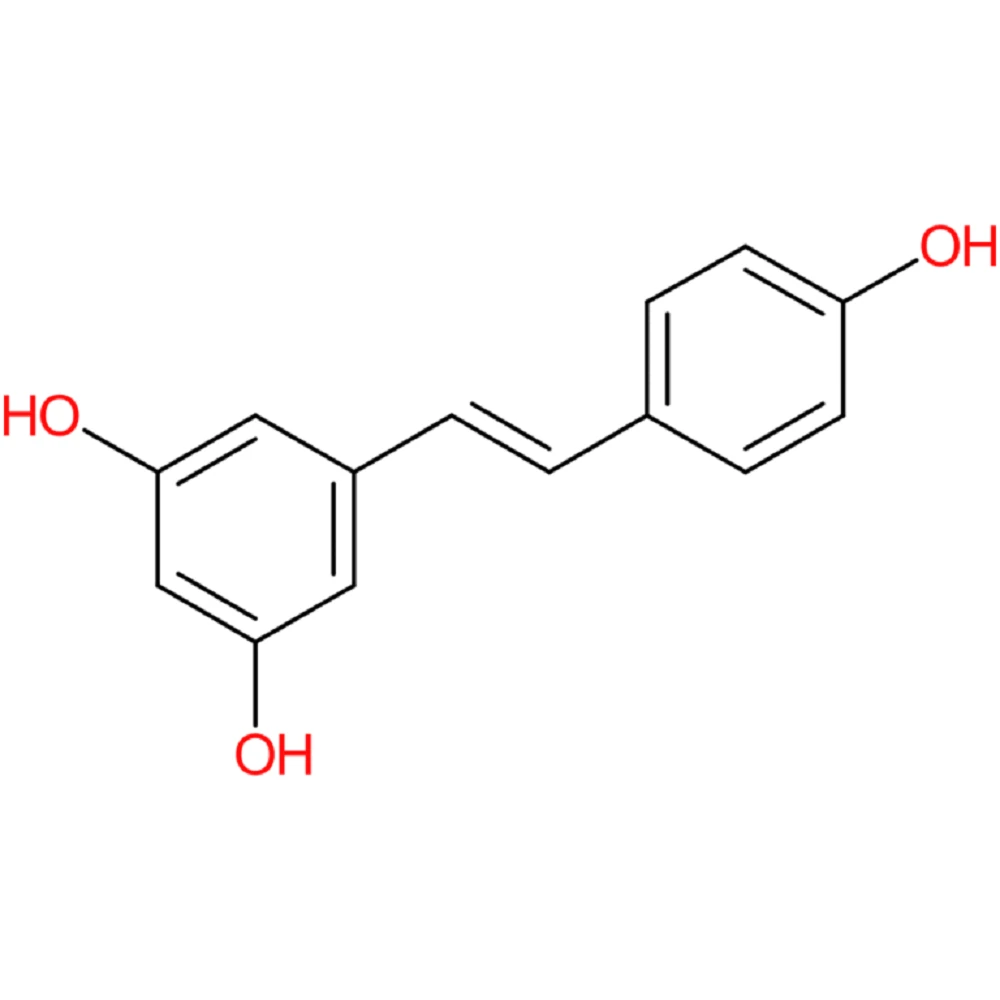
When an assay needs one peak rather than a group of them, Resveratrol from OUHE is the grade to request. It is supplied at 98% purity under CAS 501-36-0, with the formula C14H12O3 and a molecular weight of 228.247 g/mol. The lot is filed under MDL MFCD00133799 and item number A15684, and it is kept frozen and sealed until dispatch. For a laboratory preparing its own stock solutions, that combination is useful: one molecule, one formula, one weight, so molar calculations stay simple.
One practical benefit deserves emphasis here. Because the trans content is already known, a formulator can plan fill weight without a second conversion step. That clarity matters more on a low dose capsule than on a bulk powder blend, where small variations disappear into the total.
Documents and packing to confirm
OUHE can provide a certificate of analysis, a safety data sheet and technical data for the lot on request. It is worth asking which method produced the assay and whether cis was reported on its own line. Packing deserves a line of its own as well. A sealed, light proof inner liner costs little and protects a molecule that changes shape in bright light.
From trial quantity to larger scale
Programmes often begin with a small batch and grow from there. OUHE handles custom synthesis and scale up alongside routine supply, and supports export shipments with the usual packing and documentation. A trial against your own process tends to teach more than any set of figures: how the powder flows, how it disperses in a base, and whether the colour holds through filling.
Frequently Asked Questions
What is the difference between trans and cis resveratrol?
They share a formula but not a shape. The trans form is the one studied in most research and named on commercial grades. The cis form appears when light or heat twists the double bond. It is treated as a degradation product rather than an equal ingredient.
Does 98% resveratrol mean 98% trans resveratrol?
Only if the marker is named as trans and cis is reported separately. A combined total figure can include both shapes. Ask for the assay basis before you compare offers, and put the answer in writing.
Why is resveratrol packed in opaque containers?
Because light converts trans into cis. An opaque or foil lined container, ideally flushed with nitrogen, holds the assay close to its release value through shipping and storage.
What is emodin and why does it appear on a resveratrol document?
Emodin is an anthraquinone found in knotweed root, the main commercial source. Purification removes most of it, and a stated limit makes the remainder visible lot by lot.
Is resveratrol soluble in water?
Only slightly. Ethanol, DMSO and acetone dissolve it far better. Drinks and other water based formats need a dispersion strategy rather than simple stirring.
Conclusion
Resveratrol is a simple molecule with a few awkward habits. The trans shape is the one that matters, yet light and heat slowly push it toward cis. The assay figure is useful only once you know what it counts, and polydatin must be converted before any price comparison makes sense. Fix those three points and most sourcing decisions become calm, repeatable work.
The practical order is short. Name the trans isomer on the request, ask for separate cis data, set an emodin limit where the source is botanical, and insist on light proof packing with a retest date. A small trial then tells you how the powder behaves in your own line.
If you are evaluating a high purity grade for a formulation or an assay, contact OUHE with your target quantity and the grade you need to request batch documents and a quotation.